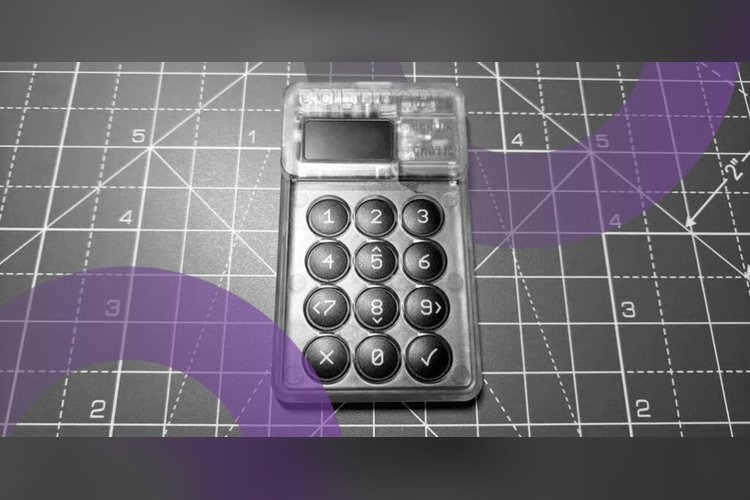
The Coldcard wallet flaw sat in shipping firmware for more than five years, and at least 15 separate security reviews failed to spot it before thieves found it. Four months after attackers emptied Bitcoin from affected hardware wallets, maker Coinkite has put out a long written investigation of how one configuration mistake stayed invisible. It follows the format of an NTSB crash report and came out on Monday.
What went wrong inside the firmware
Between March 2021 and July 2026, Coldcard devices built new wallet seeds with a software generator, MicroPython’s Yasmarang. They were meant to draw on the chip’s hardware source of randomness instead.
A seed is the master secret behind every private key in a wallet, so how random it is decides how safe the coins are. Seeds from the affected firmware carried only about 40 to 72 bits of effective randomness, far below the 128 bits intended.
That is weak enough for an attacker to guess candidate seeds on their own computer and rebuild the private keys. Nobody had to get near a physical device.
Why 15 reviews missed it
Coinkite counted at least 15 independent examinations between 2021 and 2026. Two were paid outside audits. Ledger Donjon did physical-security testing. One was an AI-assisted firmware review that returned 85 findings. Not one of them flagged the problem.
Coinkite’s explanation is that each check asked a question close to the important one but never the important one itself. Release tests verified that the hardware random-number code was in the build. They never verified that seed creation called it. Statistical tests of the output couldn’t separate the faulty generator from a correctly seeded one.
A guard inside the libNgU library was supposed to refuse the bad configuration. It failed to do so.
How many people lost money
The damage is still hard to pin down. Coinkite reports about 300 support tickets about losses, tied to 242 accounts. That is roughly 0.21 percent of its estimated users. Galaxy Research separately links more than 8,600 addresses to the thefts.
The company warns that the two numbers measure different things, so they can’t be merged into one count of victims.
The role of AI
The first thefts started two days after the full weights of the Kimi K3 model went public. Coinkite calls AI-assisted discovery a plausible hypothesis rather than an established cause.
After the flaw came to light, the Bitcoin Red Team ran Kimi K3 in a 108-hour sweep alongside other models. It surfaced nearly 8,000 candidate findings across 501 Bitcoin projects. Searching code for weaknesses has become much cheaper, and that helps attackers as well as defenders.
What changed and what users must do
Coinkite has rebuilt how seeds are made. The new design requires entropy from the user, draws on several hardware sources, and runs checks both at build time and at startup. Keylabs reviewed the work independently and concluded the defect is fully closed in the current standard firmware.
Existing seeds stay weak, though. No update fixes a seed that was already generated on an affected device, so those owners must create a new seed and move their coins to it.
Coinkite closes its write-up with a request to whoever holds the stolen coins: send them back. “Some victims lost life-changing amounts, and returning the funds is the only action that can directly reduce that harm,” the company said.
Why the gap mattered so much
Hardware wallets are sold on the promise that keys are generated and kept away from internet-connected computers. That promise only holds if the secret itself is unpredictable. When it isn’t, the offline design offers no protection, because the attacker repeats the generation step on their own machine and compares the results with public addresses.
It also means users had no visible warning. A device with weak seeds behaves exactly like one with strong seeds.
What owners should do now
If you set up a Coldcard seed between March 2021 and July 2026, check whether your device is affected and plan a move to a freshly generated seed. A firmware update alone won’t protect an old one.
For other wallet makers, the lesson is plain. Checking that a safe component exists in the code is a different test from checking that the seed path actually uses it, and the second test is the one that would have caught this.
Source: Decrypt