
Swapping a coding agent framework now costs close to nothing, but swapping the model behind it still does. Anthropic, Google and OpenAI have each moved the core agent loop into their own APIs, so the glue code teams once wrote has largely become dead weight. What remains worth owning is smaller than most teams assume.
The APIs absorbed the early framework
The first text APIs kept no state. Whatever made a model behave like a coding agent sat in customer code: arrays of chat history, homemade edit-and-check loops, parsers for diffs, retries for broken JSON, prefix caching done by hand, wrappers for searching repos, and plain while-loops around tool calls.
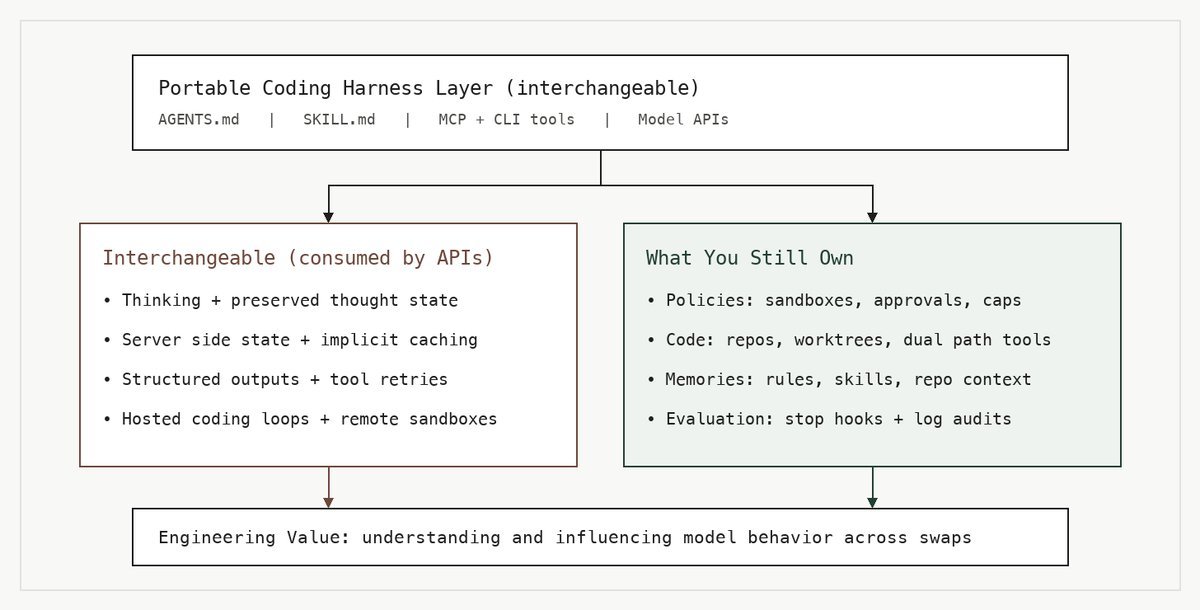
Providers have since absorbed that layer. Thinking state, implicit caching, structured outputs, built-in code and file search, stored session state and remote sandboxes now run on their servers. The agent APIs that remain are Claude Managed Agents, Google’s Gemini Interactions API and OpenAI’s Agents API. OpenAI shut down its Assistants API and launched Agents two weeks later, turning its internal Codex framework into a cloud endpoint.
Open specs cover the outer contract. AGENTS.md, SKILL.md and MCP work across frameworks such as Antigravity, Claude Code and Codex. A coding agent can rewrite the plumbing for a new SDK in an afternoon.
Why a coding agent framework is not like a container
The comparison is Kubernetes. A decade after the CNCF launched, the Agentic AI Foundation is doing similar standards work. But containers run on hardware that behaves alike. Models don’t. Think ARM versus Intel, except both accept the same input and return different output.
Three examples from one developer’s machine show the gap:
- With the same AGENTS.md rules and the same ast-graph plugin, Gemini 4 Argon consulted the tool schemas and queried the graph in most sessions. Claude Opus 5.5 ignored the schemas and kept running grep in bash. The exception was FreightFloor, where a small shell script gave it a way to reach the graph.
- Old UI rules written for smaller Flash models were still sitting in the repos. Opus passed over the skill menu and produced tidy layouts from its own defaults. Gemini obediently followed each matching skill and delivered messy brown dashboards dotted with static pills. Removing 95% of the agent configuration repaired the UI output.
- On a rebuild for a projector viewed from ten feet away, Gemini began by opening a built-in web guidance skill. Opus never opened it and made desktop-style dropdowns until someone told it the screen wasn’t a desktop browser.
Switching models, or upgrading inside one vendor, changes the agent’s habits.
The four layers still worth owning
Writing your own edit loop or retry wrapper today resembles building a container scheduler ten years ago. What deserves your effort is the set of limits a model cannot impose on itself, plus feedback loops that catch drift when you change models.
- Policies outside the prompt: operating-system sandboxes for commands, approval rules that default to blocking shell access and file writes, and hard limits on spending or tokens. On FreightFloor, an outdated spend counter plus crawler traffic took launch week beyond $120 before anyone looked at the bill.
- Code and dual-path tools: git worktrees for parallel branches, firm boundaries around private repos, and important dev tools offered through both MCP and a command line, because models differ in which they prefer.
- Memories and repo context: coding rules, skills and project context kept in plain open files, with stale instructions pruned before they confuse newer models.
- Evaluation and verification hooks: checks that refuse to let a session finish while tests fail, hooks on edits that refresh local code indexes, and a review of session logs each time the coding model changes.
What teams should do this week
Look at what your team calls its coding agent framework or framework. Remove the retry loops, cache code and tool wrappers that the model APIs now cover. Keep repo workflows in AGENTS.md, SKILL.md and simple CLI or MCP sidecars so a framework switch stays cheap. Then spend the saved time on policies, code, memories and reading session logs after each model swap. The author’s advice is that you will usually find a surprise there.
Source: The Davenporter