Nvidia says its co-packaged optics switches have reached volume production, and it will expand optics manufacturing 15x in 2027. Interim CEO Colette Kress said so on the November 17 earnings call. One day before, cloud provider Lambda announced it had connected over 10,000 Blackwell Ultra GPUs through such switches in Quebec.
Yet Nvidia and Cisco also announced a new pluggable module format, USFP, in October. If the sealed design has won, why build a better plug-in module? The answer comes down to two engineering questions: how far the electrical signal travels, and what you replace when a laser dies.
Why a shorter signal path saves power
On raw bandwidth the two designs are equals. Nvidia’s Quantum-X Photonics has 144 ports of 800G, and a Broadcom Tomahawk 6 switch delivers 102.4T with either approach. The difference is the distance the signal covers as electricity before it becomes light.
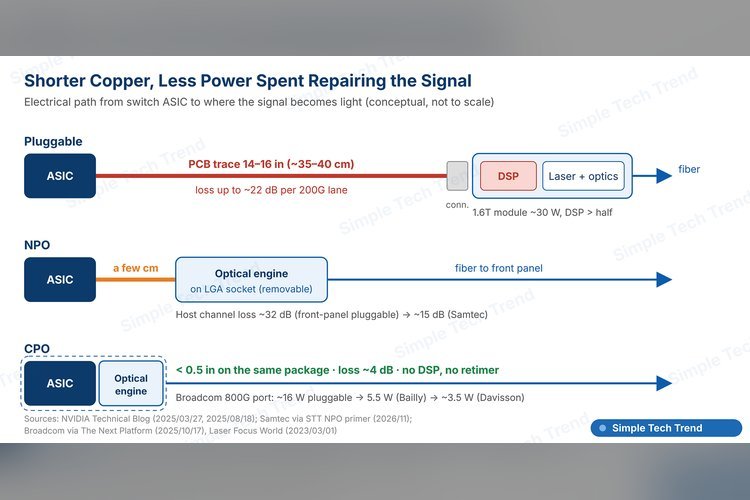
A traditional switch routes signals across the board, roughly 14 to 16 inches (35 to 40 cm), to a module at the front panel. At 200G per lane the signal degrades on the way, so every module carries a DSP to repair it. Nvidia measures up to 22 dB of loss on that route. Mount the optical engine on the chip’s own package and the run shrinks to under half an inch, with about 4 dB of loss. No DSP is needed.
The DSP is the biggest power consumer in a pluggable. Nvidia puts a 1.6T module near 30 W, more than half of it going to that chip. Broadcom says its Davisson switch needs over 70% less power per port. Meta tested Broadcom’s earlier Bailly generation and measured 65% less per 100G lane than retimed modules, and 35% less than linear pluggable optics, a variant that already drops the DSP.
Across a 100,000-accelerator cluster, one estimate has pluggable optics drawing about 192 MW, linear optics 64 MW and co-packaged optics 42 MW, next to roughly 400 MW for the GPUs.
The cost: you can’t pull the optics out
Keeping the path that short forces the optical engine onto the same substrate as the switch chip, which needs advanced packaging such as TSMC’s COUPE. The trade is serviceability. One bad optical chiplet can knock out 8, 16, 32 or more ports together, while a dead pluggable costs a single port.
What happens when the laser fails
Silicon can’t produce light, so each optical engine depends on an indium phosphide laser. It runs hotter than anything else in the link and wears out first. The Advanced Photonics Coalition sets a ceiling of 100 FIT (100 failures per billion hours) per laser source. At that rate, a system with 1,024 sources would see a failure about every 13 months.
Vendors answer with an external laser source (ELS): a separate front-panel module whose light travels by fiber to the engine in the package. Broadcom’s three generations show how this matured. Humboldt used remote lasers, yet any fault meant replacing the whole switch. Bailly made the lasers detachable. Davisson lets technicians swap them from the front.
Nvidia also needs fewer lasers: 2 per 1.6T against 8 in a pluggable, which lowers laser power from about 10 W to about 2 W. Each Lambda switch pairs 144 800G ports with liquid cooling and 18 removable light sources, or about 8 ports per source.
The reliability claim
Nvidia claims 15x higher reliability than pluggables, plus 5x better power efficiency and 10% lower latency. Lambda offers a physical explanation: its optics ran at a median 36°C, against 51°C for pluggables, and cooler parts age more slowly.
The catch: how often something fails differs from how much a failure hurts. Failures may be rarer, but each one reaches more ports. Meta logged 1 million device hours on Bailly at 400G-equivalent ports without a single link flap, but that came from lab stress tests. Its pluggable figures come from live data centers, so the comparison isn’t like for like.
Where pluggables and near-packaged options fit
Pluggables burn about 14 to 18 W per 800G port, yet they come with a mature supply chain and easy swaps. USFP runs 400G per lane, starting at 16 lanes and growing to 32 or more for 12.8T. Nvidia and Cisco cite 4x the bandwidth density of 200G-per-lane modules, about 1.3x better efficiency, and up to 100 W without special cooling. The efficiency gain trails the 3.5x to 5x Nvidia claims for its optical switches, and both companies say the point is to preserve serviceability.
Near-packaged optics split the difference. The optical engine is its own module in a socket beside the chip, and Samtec figures show host-side channel loss falling from about 32 dB to about 15 dB.
What to watch through 2028
The power case for co-packaged optics looks settled. What’s missing is multi-year field data on sealed optical engines. For now the evidence is Meta’s lab hours, Lambda’s freshly switched-on deployment and Nvidia’s own claim.
Test equipment is early too. Keysight told investors in November that this testing becomes meaningful in 2027, with a larger step in fiscal 2028. Davisson draws about 3.5 W per 800G port, and NTT’s 102.4T optical switch is due for commercial launch by the end of fiscal 2026.
Co-packaged optics shipments should climb in 2027, but wholesale replacement of pluggables probably waits for field failure records and test capacity in 2028. If Lambda or Meta publish failure and replacement data over the next year, the pluggable market’s outlook gets much easier to call.
Source: Simple Tech Trend