
China’s AI compute infrastructure points to a government focused on spreading AI through the economy, not racing toward near-term artificial general intelligence. That is the conclusion of a new analysis that tests whether China could have supported a frontier training run in February 2026. It could not have, at least not at a site anyone can see.
The test case is Anthropic’s first Mythos model, which marked the frontier that month. The analysis estimates it took about 5e26 FLOP to train, equal to roughly 330,000 H100 chips running for three months at 20% effective utilization.
Two strategies, two compute footprints
The analysis separates two broad outlooks. A government that expects AI to be significant but ordinary would favor inference compute spread across many providers, so industry can use AI close to where it’s needed. A government that expects AGI within a few years would centralize compute for giant training runs and favor training over serving users.
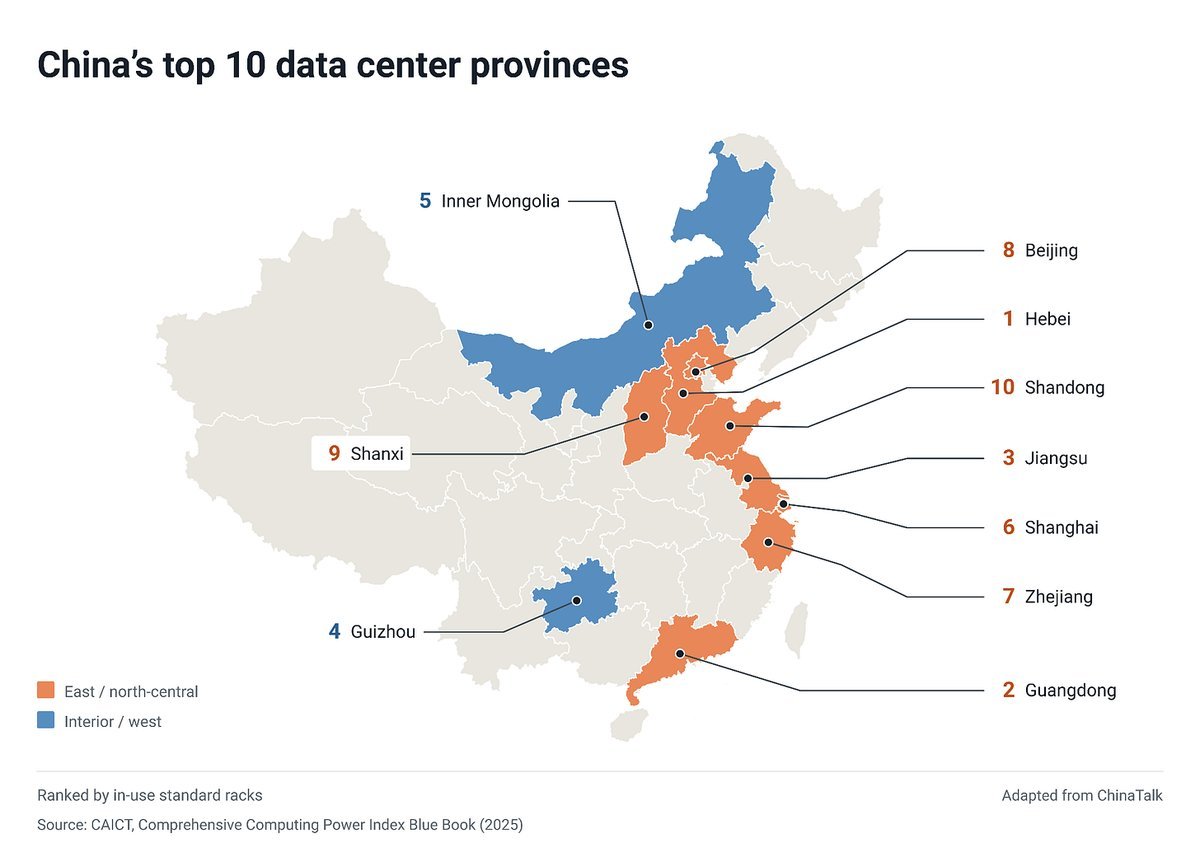
Total compute can’t tell them apart, since both outlooks call for more chips and data centers. China clearly takes AI seriously: in March 2025 it held about 15% of global AI compute against 75% for the US, and nearly three times the European Union’s capacity. It is also building faster than it can fill. Data centers in its national computing hubs averaged a 62% racking rate in 2024, with some western provinces at 30% to 40%. North American facilities had a 1% leasing vacancy rate.
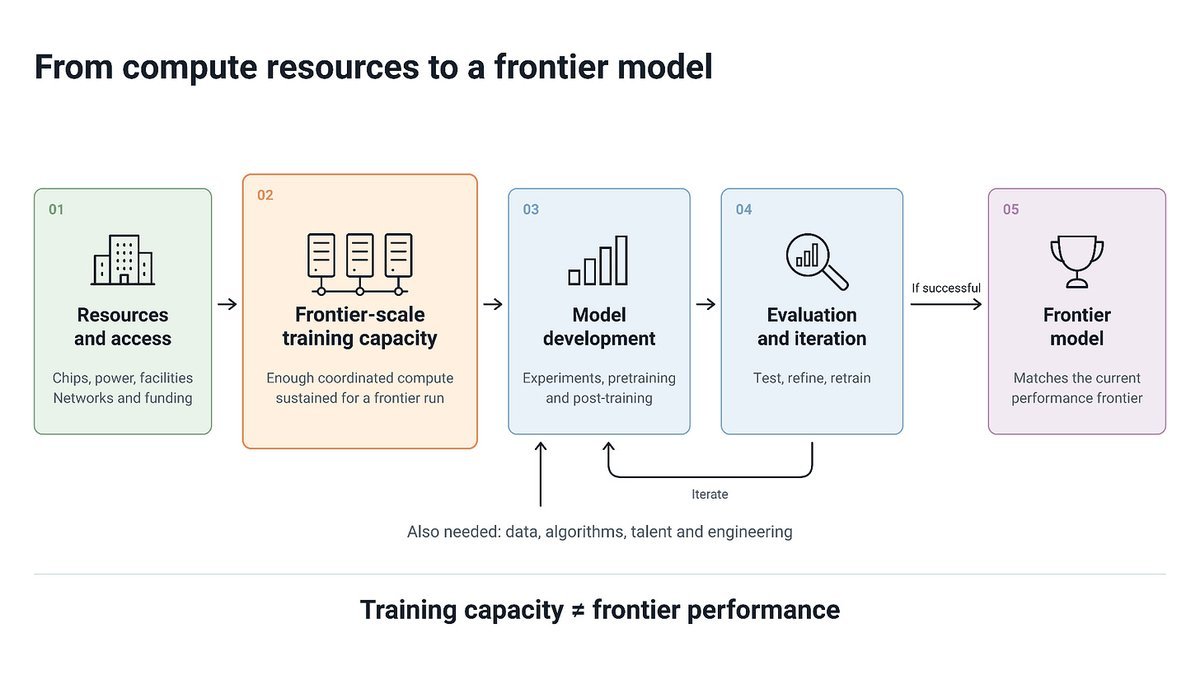
Could China have trained a Mythos-scale model?
Epoch AI estimates China held about 1.8 million H100-equivalents in late 2025. A Mythos-scale run would have used about a fifth of that for three months. Feasible on paper, but only if the chips sat in one place or in tightly linked sites.
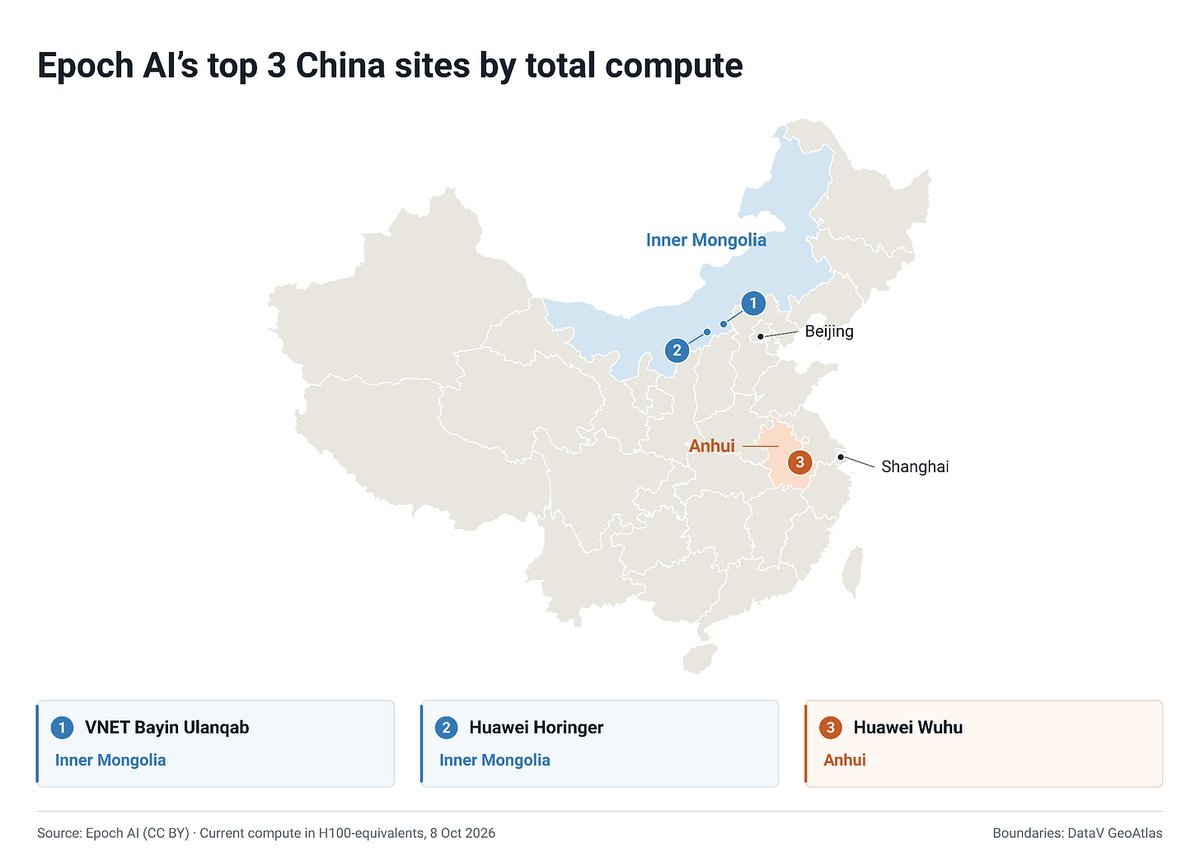
The largest known site, VNET Bayin Ulanqab, held an estimated 123,000 H100-equivalents in February 2026. That is about a third of what the run needed. Epoch’s list is not complete, yet the biggest data centers draw the most power and give off the most heat, so they are the hardest to hide. The five Chinese sites it tracks held about 210,000 H100-equivalents combined.
Linking many sites is harder to rule out, though it faces its own barriers:
- No single body appears able to commandeer compute across several sites as of mid-2026.
- China’s national compute networks are built to match idle capacity with users, not to coordinate one training job.
- Training across sites costs efficiency. Going from one site to eight needs about 1.5 times the compute for the same performance.
What released models and chip decisions show
Moonshot AI’s Kimi K2.5, released in January 2026, has 32 billion active parameters and was trained on about 30 trillion tokens. That works out to roughly 5.8e24 FLOP, nearly 90 times less than a Mythos-scale run. It suggests Chinese companies are shipping cheap-to-serve fast followers, not frontier systems.
The H200 saga points the same way. After the US allowed Nvidia H200 exports in December 2025, Chinese customs blocked imports in January 2026. Beijing later approved purchases of more than 400,000 H200s by Alibaba, ByteDance and Tencent, but shipments stalled. The first deliveries, around 10,000 each to ByteDance and Tencent, came in August, and most chips must stay outside the mainland, for example in Hong Kong. In November, about 600,000 H200s were reportedly piling up there, and Nvidia said it had stopped shipping its licensed AI chips to China.
An H200 has about the same compute as an H100, so the 400,000 approved chips alone would likely have covered a Mythos-scale run. A government chasing the frontier would hardly give that up for bargaining power in trade talks.
Geography doesn’t fit a frontier push
The Eastern Data, Western Compute project, launched in 2022, aims to move compute to western hubs with cheaper power and land. In practice most compute remains near Beijing, Shanghai and the Greater Bay Area. Three of Epoch’s five largest Chinese sites are in Inner Mongolia, one is in Hebei and one is in Anhui, all fairly close to those commercial centers.
What to watch next
The analysis stresses its limits. Uncertainty over capacity, utilization and links between sites caps how much infrastructure can reveal about policymakers’ beliefs, and a change in strategy would appear in policy well before it appeared in buildings and cabling.
The next clues are planned buildouts. Z.ai has reportedly completed a 1 GW data center that uses only Chinese chips, though only part of it runs, and DeepSeek reportedly plans one that would begin coming online in late 2027 or early 2028. Extrapolating the 5x annual growth in frontier training compute, such a facility is unlikely to support a frontier run by then. Signs of a shift would be larger western sites, dedicated high-bandwidth links between data centers, a system for coordinating training compute and government statements that put training ahead of inference.
Source: the-substrate.net