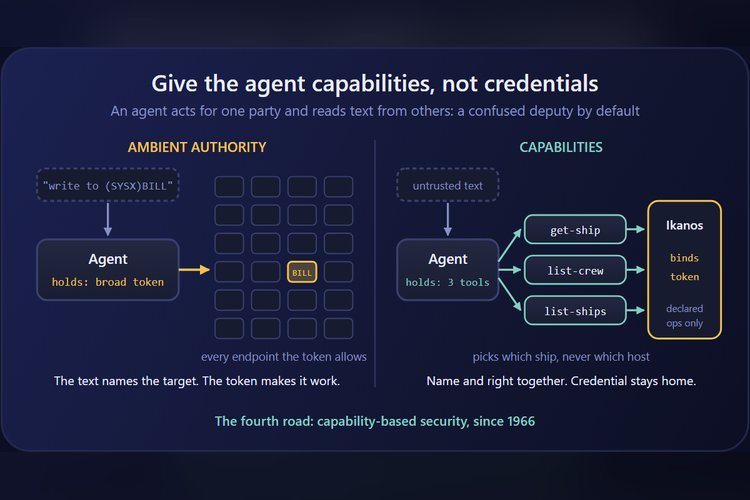
Capability-based security is a 1960s idea that explains why prompt injection works on AI agents, and it points to a cure: hand agents narrow capabilities, not broad credentials. The team behind Ikanos, a spec format for describing what agents may do, makes that case.
They argue that API designers, context engineers and platform engineers already use the word “capability” for what a system offers. Security engineers got there first, and their meaning answers a question the others skip: once an agent can act, what is it allowed to do?
Origins of capability-based security in 1966
Jack Dennis and Earl Van Horn laid out the object-capability model in a paper on multiprogrammed computations in March 1966. Their core idea: authority travels as an unforgeable token. Possessing the token is the permission, and it can be passed to someone else.
Operating systems and research machines built on it for decades, from Hydra and KeyKOS to seL4, FreeBSD’s Capsicum, Fuchsia and WASI. Even the humble Unix file descriptor works this way, because any process holding one can use that file.
Business architecture borrows the same word for something different. There, a capability describes what an organization or system is able to do. Security capabilities describe who gets to do it. An agent needs the two meanings to line up.
Why agents behave like a confused deputy
Norm Hardy described the problem in 1988. A compiler held two sets of rights: it could write debug output to user-chosen paths, and it could touch the system directory containing billing records. One user supplied the billing file’s path as the debug target. The compiler used its own privileges and wiped the records. Nobody had given the user that power. The compiler lost track of which authority applied.
Agents repeat the pattern daily. They hold a user’s credentials and process emails, web pages, tickets and tool output that outsiders can influence. A planted instruction asking the agent to mail out a customer list makes the agent spend its own privileges on an attacker’s goal.
That is prompt injection in a sentence. Simon Willison’s “lethal trifecta” (private data, untrusted content and a way to communicate externally) describes the same hazard with a network link attached.
The ambient authority trap
Most agents run on ambient authority. A single broad OAuth token sits behind an MCP server exposing 300 endpoints, and whatever the token permits, the agent can attempt on any target mentioned in its input.
The remedy is older than the web: attach the permission directly to the reference. The CaMeL paper, published in March 2025, applies capabilities to keep private data from leaking out of agent systems.
How Ikanos specs approximate it
An Ikanos spec lists capabilities as business features, but its schema also imposes limits that resemble security capabilities:
- An agent sees only the tools its author declared, and each tool maps to defined operations.
- The engine keeps the secrets. The caller’s own token is not passed to upstream services.
- Upstream hosts are settled when the spec loads, using binds. Call arguments can pick a ship, not a harbor.
- Agent identity feeds the audit trail only and never approves a request.
The host rule helps most against injection, since an attacker’s text has no field in which to name a destination. And because the whole spec is a file, changes to what an agent may do pass through code review, which a token can’t offer.
Limits of the approach
The team is open that this falls short of a true object-capability system. Permissions apply per adapter instead of per call, so an agent attached to an MCP adapter can use every tool on it. It can’t create a narrower tool for a sub-agent. Taking access away means editing the spec or rotating a credential. Per-agent authorization has to come from a gateway placed before the adapter.
Injection remains possible too. An agent allowed to send email can still be tricked into sending the wrong one. The gain is a smaller blast radius: the agent holds only what the spec grants, and no one can steer it toward a destination the author never named.
What builders can do now
For anyone shipping agents, capability-based security translates into a few habits. Grant each tool one resource and one right. Keep secrets and destination hosts inside the runtime rather than in prompts or arguments. Put delegation and per-agent policy in a gateway. Business meaning and security meaning of “capability” now describe one object, and agents are the first consumers who depend on both.
Source: naftiko.io