AI agents are splitting into two kinds, and the difference decides who they answer to. Butler AI agents serve one person. Gardener agents look after a shared space. That’s the argument from Nicholas Carriere, who works at Notion.
Both kinds are a loop that calls tools against a goal, so they look identical from the outside. Carriere says mixing them up leads to bad products.
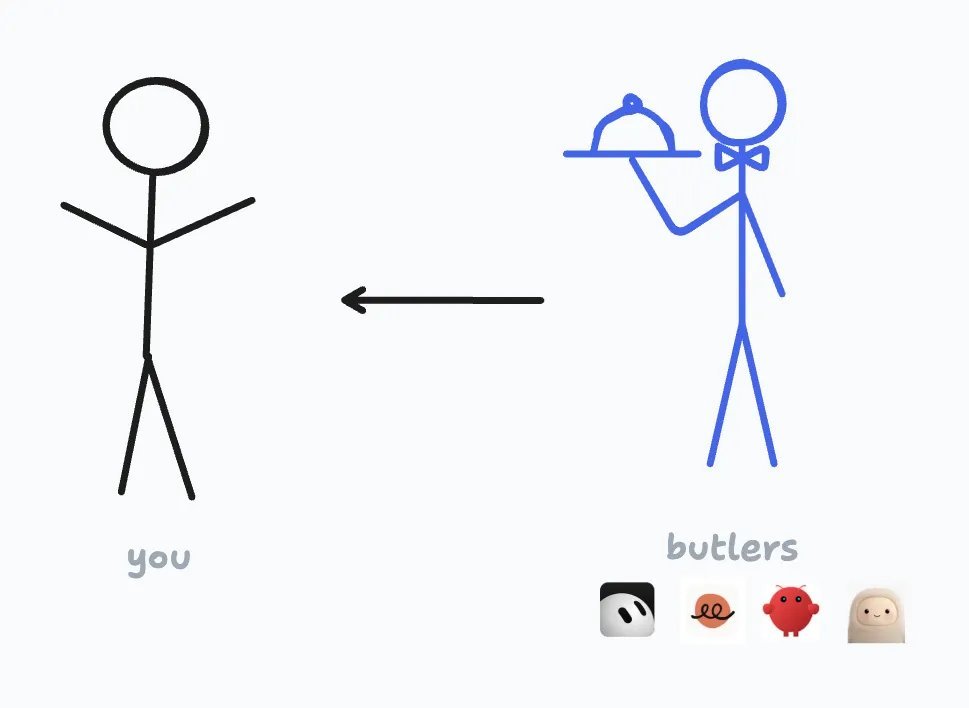
Butler AI agents attach to a person
Carriere places OpenClaw, Grok Bot, Muse, Duet and Dot in the butler camp. Each is a generalist that can do many tasks, yet each is tuned to one user: their preferences, their job, their working style. They spend tokens solving that person’s problems their way.
A lot of knowledge work fits this pattern. You set a goal, break it into tasks and produce artifacts such as a code pull request, a slide deck or a document. The collaboration comes later, but the process leading up to it is private.
Butler AI agents are single-player by nature, which makes them easier to build. Carriere expects the AI labs to own this category. Their individual subscription plans give out tokens at prices well below their API rates for larger teams.

Gardeners tend a place
The second type isn’t tied to anyone. It’s responsible for a place that outlives the people working in it, such as a codebase, a CRM or a company’s internal knowledge base.
Carriere offers a quick test: when an employee leaves, does the agent leave too? A butler goes with its person. A gardener stays with the ground.
Code already works this way
Software teams show the split clearly. Each developer now runs a personal coding agent set up their own way, and all of them work in one repository that will outlast every one of them. Agents that belong to the repository itself, like the code review bot Greptile, are gardeners.
The pull request is the mechanism that holds this together. A butler states what it intends to change, and the repository’s own process decides whether the change gets in. That’s why ten coding agents can share a repo without wrecking it.

Why butlers shouldn’t garden
Carriere cites a point from LangChain’s Harrison Chase, who calls gardeners “curator agents”. Agents focused on their own goals tend to maintain shared knowledge badly, and the result becomes unruly and full of contradictions.
A butler might spot a weed. It won’t take responsibility for pulling it. One gardener maintaining the space is both cheaper and more reliable than ten butlers each patching it. The reverse also holds: a butler is only as good as the garden it works in, because a stale wiki or a messy database produces bad answers from even the best model.
The two types are also bought differently. Butlers are paid for per token, per individual. Gardeners are AI workflows running at scale on company accounts, so buyers are paying for outcomes and data guarantees rather than labor tokens.
Company knowledge is the next garden
Carriere thinks company context is the next place this plays out. He describes gardeners as things like a wiki that updates itself, an agent that watches database changes and checks that entries are typed correctly, and meeting-note skills that evolve based on surrounding signals.
He also raises an open problem. If some butlers run cheap, low-intelligence models, they could damage a shared knowledge base and degrade every other agent that reads it. How to defend against that isn’t settled.
What comes next for butler AI agents
As butlers multiply from dozens to thousands, Carriere doesn’t expect them all to edit shared spaces directly. He predicts agent-to-agent protocols will move from MCP-style create, read, update and delete APIs toward intent-based messages. On the read side, an agent says what it intends to do and asks for relevant context. On the write side, it describes the semantic change it wants to make.
Only the gardener decides whether the change happens and what exactly it looks like, given the rules of the garden. Vercel’s recent board product, with forums, feeds and channels for agent swarms, is one early example of this kind of coordination.
His practical advice is a single question for anyone building or using an agent: does it answer to a person or to a place?
Source: Nicholas Charriere