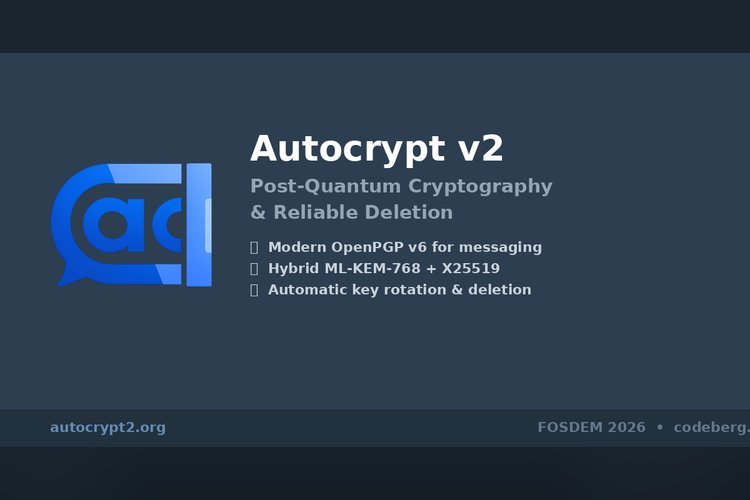
Autocrypt v2 is a new design for encrypted messaging that protects against quantum computers and makes message deletion hold up over time. It uses a hybrid of ML-KEM-768 and X25519 and is built on the OpenPGP v6 standard from RFC 9580. A draft specification was planned for the first quarter of 2026, with app releases targeted for the fourth.
The threat: decrypt later
The project describes attacks that play out in three stages. Today, adversaries collect encrypted messages while they are in transit. Within months to years, they may obtain secret keys and decrypt even messages the user thought were deleted. Over years to decades, quantum computers could decrypt everything that was gathered. Autocrypt v2 is meant to cover both of the later scenarios.
What changed from version 1
Version 1 was focused on email and tied to the email address, which served as the identity layer. Version 2 is transport agnostic and uses a purely cryptographic identity. The goal is unchanged: automatic, standards-based, interoperable end-to-end encryption.
The design targets decentralized messaging systems that tolerate delays. The project says it works over existing internet messaging infrastructure and needs no user action.
Hybrid post-quantum encryption
The hybrid approach pairs ML-KEM-768, a post-quantum algorithm that is a NIST standard, with X25519, a classical elliptic curve. If either algorithm holds up, the combination stays secure. That gives protection against both classical and quantum attackers.
Certificates are compact. Each one is a fixed 2,938 bytes and consists of six packets. The primary key is an Ed25519 key used for signing and certification, and a direct key signature defines features without an expiry. Subkey bindings follow, and one of them expires after max_rd, which defaults to 10 days.
How reliable deletion works
The project prefers the term reliable deletion over forward secrecy because it is clearer for users. Deleted messages are supposed to stay gone even if a key leaks later.
Traditional approaches often need network sync, central servers or complicated multi-device handling. Autocrypt v2 relies on the clock instead. Keys rotate on a schedule, work offline, and need no coordination between devices.
Each device derives the next rotating subkey from the previous one with HKDF using SHA2-512. The derivation yields 160 bytes: 64 of them are hashed into a 16-byte salt for the binding, and 96 become the next subkey secret after normalization. Because the derivation is deterministic, every device lands on the same keys without talking to the others.
A rotating subkey stays valid for max_rd, and the next one is generated at min_rd before expiry. The spec assumes a delivery delay of 10 days and deletes keys automatically after max_rd plus 10 days. The slides also describe rotation about every 5 days, as set by min_rd.
Two kinds of encryption subkey
A certificate carries two types. The fallback subkey is a long-term hybrid key used only when no rotating subkey is valid. Messages encrypted to it are not reliably deletable. The rotating subkey is short-term, must be used whenever it is valid, and is destroyed after it expires. Messages sent to it can be deleted reliably.
When a client manages peer certificates, it merges incoming ones into a local cache and prunes expired keys. It never uses the fallback while a rotating key is available, and among valid rotating keys it picks the one that expires earliest so deletion comes sooner.
What it can’t do
The project is open about a limit. Deleting a message everywhere requires removing every copy on every device, including backups and offline devices. That coordinated deletion is outside the scope of Autocrypt v2. It points to apps such as Delta Chat and Signal, which offer coordinated deletion.
Roadmap and who can join
The plan runs through 2026. The draft spec was due in the first quarter, implementation in the second, testing and polish in the third, and app releases in the fourth. Clients and bots listed on chatmail.at are expected to upgrade without extra steps. The developers are asking for outside implementers, especially experienced Rust developers interested in chatmail and Delta Chat. Examples exist for rPGP and Python.
If the plan holds, messengers built on chatmail could gain post-quantum protection and deletion that survives a later key compromise, without asking users to change anything.
Source: autocrypt2.org