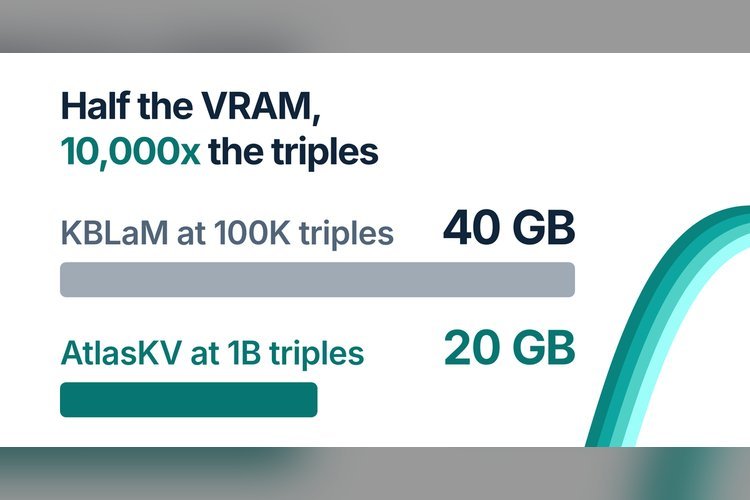
AtlasKV does not replace RAG, despite the buzz around it. The research method packs a billion knowledge graph facts into an 8B-parameter LLaMA 3.1 model on under 20GB of GPU memory, yet it only covers one narrow slice of retrieval: questions over a structured knowledge graph.
The authors work at HKUST and Huawei’s Theory Lab, and the paper went to ICLR 2026. Code is public under an MIT license, but this is research, not a product.
What AtlasKV does
AtlasKV turns each graph triple into a key vector and a value vector and feeds them into the attention layers of a language model whose weights stay frozen. Only a few attention heads are trained, and their job is to find the right fact for a question. The model needs neither a separate retriever nor a long prompt.
It belongs to the same family as KBLaM, a 2024 Microsoft Research method that showed knowledge could be attended to instead of pasted into a prompt. AtlasKV adds two things: better training data and a way to stop attention cost from growing with graph size.
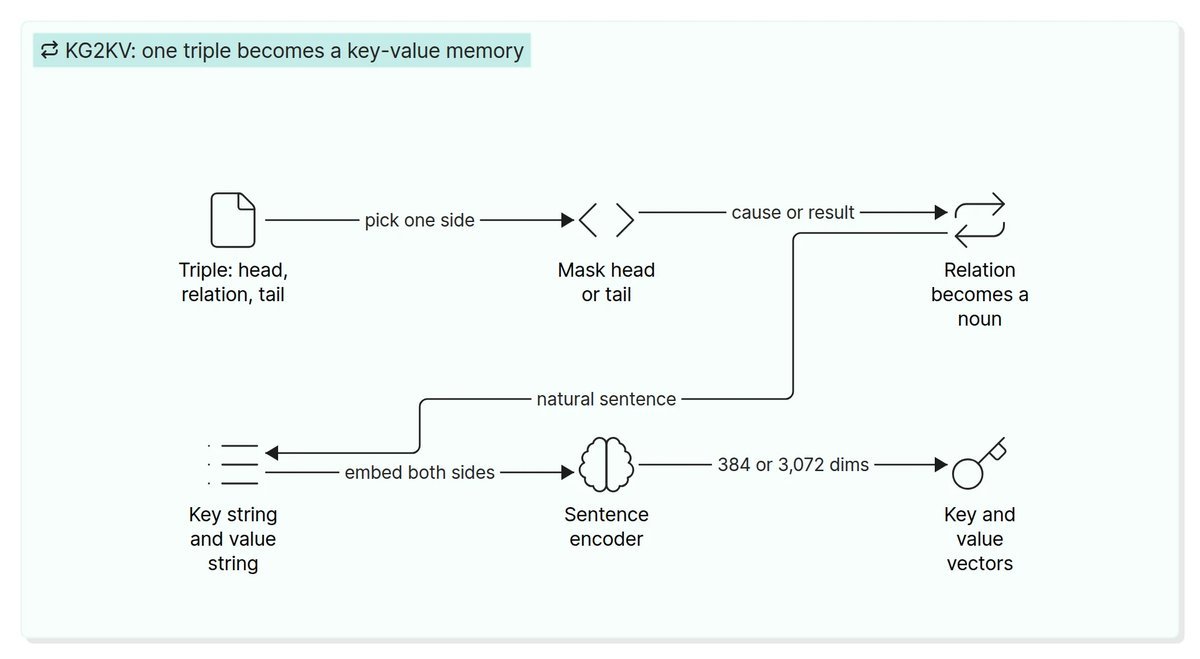
KG2KV: building the keys and values
KG2KV prepares the training data. Take the triple “John founded StockLemon.com”. One end of the triple is hidden and the relation becomes a noun. The key combines the visible entity with that noun and ends up phrased like a query. The value restates the hidden entity in a sentence. A sentence encoder embeds each string, and the two embeddings go into attention.
Since the relations are drawn from an actual graph and not a hand-built schema, the training set covers many more question shapes. The paper puts the diversity ratio at 7.864% for KG2KV versus 0.003% for KBLaM’s synthetic data, with 165.7 tokens per sample on average versus 349.9. That diversity helps AtlasKV ground answers on test sets with question types it never saw in training.
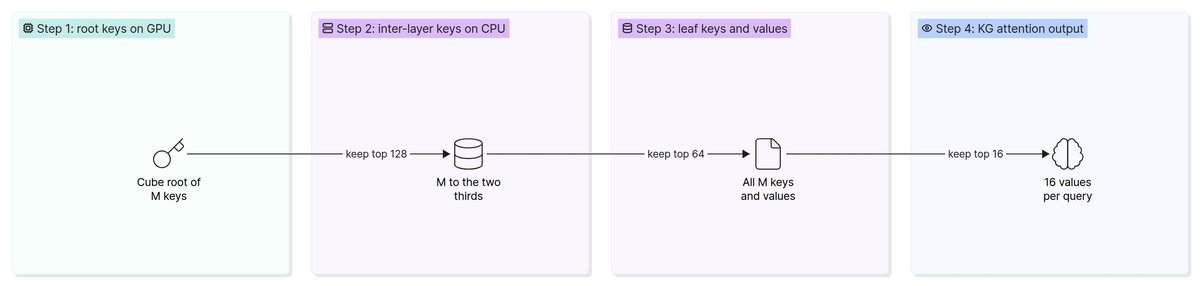
HiKVP: how 1 billion triples fit in 20GB
The model doesn’t keep every vector on the GPU. Hierarchical key-value pruning (HiKVP) sorts the keys into a tree with three levels. UMAP shrinks the dimensions and Gaussian mixture models do the clustering. Only the top level of keys stays on the GPU during a query.
- Score the root keys and retain the best 128.
- Follow those links down a level, score again and retain 64.
- Score the remaining leaf keys and retain 16. Their values go into the attention step.
Lower levels are loaded from CPU memory when required. Cost no longer grows in step with graph size, and instead grows more slowly. For contrast, KBLaM needs more than 40GB to hold only 100,000 triples, so AtlasKV handles about 10,000 times as many at half the memory.
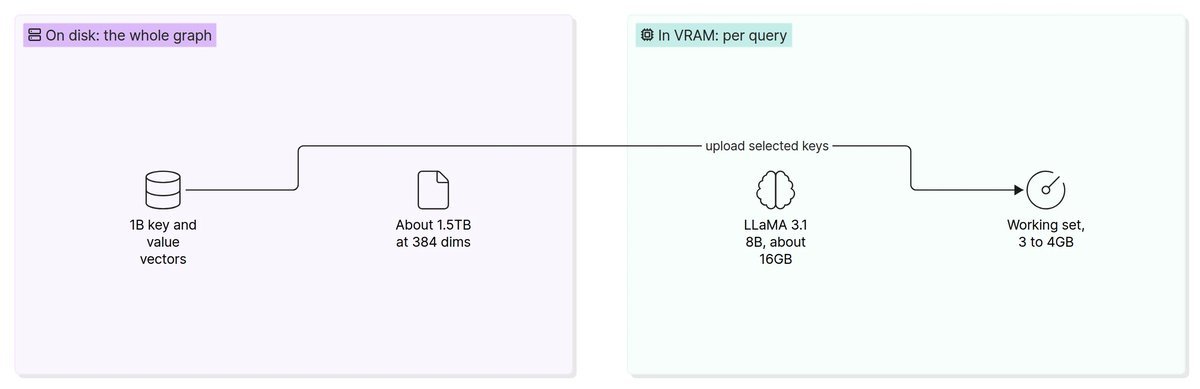
Where the knowledge lives
The graph still has to be stored. Do the sums: a billion triples, two vectors each, 384 dimensions from the all-MiniLM-L6-v2 encoder, at 16-bit precision. The key and value store comes to about 1.5TB. That sits on disk and CPU memory. You skip a managed vector database and a chunking pipeline, but not a very large embedding store, and not the offline job that embeds every triple. The project README excludes that job from the VRAM figure.
The model is small next to that, at about 16GB in bf16.
How accurate is it?
Accuracy was measured as knowledge grounding. The authors read attention scores at layer 15 and asked whether the right triple came first or within the top five. Tests used three datasets unlike the training data, with graphs of 10 up to 10,000 triples.
AtlasKV wins at every graph size on the two hard datasets. On ATLAS-CC-QKV with 10,000 triples, it ranks the correct triple first 40.0% of the time, versus 3.6% for KBLaM. On ATLAS-Pes2o-QKV at 1,000 triples it’s 52.7% against 5.5%. The Enron set is mixed: at 1,000 triples, Top-1 improves from 29.1% to 41.8%, but its Top-5 rate falls, from 56.4% to 50.9%.
Pruning has a price. Without HiKVP, ATLAS-Pes2o-QKV at 1,000 triples rises from 52.7% to 72.7%.
Why this doesn’t end RAG
Four limits stand out.
- The method needs a graph as input, not a pile of documents. Contracts, inboxes and call transcripts aren’t triples, and converting them is a separate, expensive project. The authors point to AutoSchemaKG for graph construction.
- Accuracy was only tested up to 10,000 triples. The billion-triple figure is a peak VRAM measurement.
- The VRAM figure leaves out the offline embedding job, and HiKVP adds CPU to GPU transfer latency. The latency table compares AtlasKV with and without pruning, not with RAG.
- KG2KV handles each triple on its own, which flattens the graph structure. The authors themselves warn that multi-hop reasoning may suffer.
What teams should do next
Teams with an existing knowledge graph, or data that is relational by nature, could run a short trial of AtlasKV. If your knowledge lives in documents, hybrid retrieval over chunks is still the practical choice, with a graph layer only where questions are truly relational.
A sensible test is narrow: build a graph from one dataset, train the heads as the paper does (3,000 steps over 20,000 samples), then compare Top-1 grounding and end-to-end latency at several graph sizes against a hybrid retrieval baseline. The headline 20GB leaves out the 1.5TB on disk and the tuning run.
Source: Flowtivity