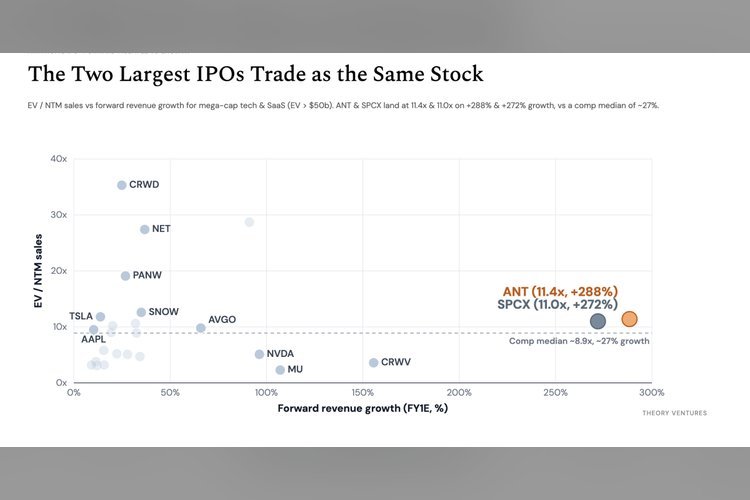
The Anthropic SpaceX valuation comparison turns out to be close to a coincidence of arithmetic. The two biggest IPOs in history trade within 15% of each other’s market cap, report trailing revenue within 10% of each other, and sit on an identical forward multiple of about 9.5x revenue.
The numbers come from market data dated November 20, 2026, and they raise a pointed question: if both companies are growing faster than any software company before them, why doesn’t the market pay more?
The numbers side by side
Anthropic trades near $86 a share. That gives it a market value of about $1.56 trillion and an enterprise value of $1.30 trillion after $254 billion of net cash. SpaceX has a market value of $1.82 trillion and an enterprise value of $1.71 trillion.
Trailing revenue is $35.3 billion for Anthropic, with a trailing gross margin of 22%. SpaceX reported $32.0 billion for the twelve months ended September 30, 2026, in its Form 10-Q, with a nine-month gross margin of 62%.
Against 2027 consensus revenue, SpaceX’s enterprise value works out to 9.45x on $181 billion, and Anthropic’s to 9.49x on a $137 billion street estimate.
Growth doesn’t change the price
Here is the odd part. SpaceX is projected to grow 46% faster than Anthropic, yet the market charges both the same multiple. Implied growth from trailing revenue is 466% for SpaceX and 288% for Anthropic.
Across 24 mega-cap software and infrastructure names, both land in the middle of the pack, even though they grow roughly ten times faster than the median. Investors are valuing them like companies growing 20%, not 200% or more.
A ceiling above $1 trillion
Widen the view to the trillion-dollar hyperscalers and the ceiling is hard to miss. Above $1 trillion of enterprise value, no company trades much above 10x forward sales, whether it grows 16% or 466%.
The anchor is earnings, not revenue. Every trillion-dollar hyperscaler trades in a tight band of 20x to 26x earnings. The math then caps the revenue multiple:
- At Microsoft’s 41% net margin, 26x earnings caps forward revenue near 10x.
- At the margins of Meta and Google, 20x earnings caps it near 5x.
Alphabet shows the pattern. Its enterprise value is $3.24 trillion against 2027 consensus revenue of $636 billion, with 27% forward growth, a 61% trailing gross margin and a 20.4x forward P/E. Pure hardware names are treated separately: Nvidia is at 5.1x forward sales and Tesla at 11.8x.
On next-twelve-month revenue, rather than 2027, both Anthropic and SpaceX land near 11x.
What it means for Anthropic and SpaceX shares
The market isn’t debating whether Anthropic or SpaceX is the better business. At this scale, multiple expansion is over, and the only way either stock compounds is by growing into its earnings.
That matters for the gross margin gap. Anthropic’s 22% trailing margin sits well below SpaceX’s 62% over nine months, so converting revenue growth into profit will be a different job for each company.
Why earnings set the limit
The logic is simple. A stock that trades at a fixed multiple of earnings can only support a certain multiple of revenue, and that depends on how much of each sales dollar turns into profit. Microsoft keeps more of its revenue as profit than Meta or Google, so the same earnings multiple supports a higher revenue multiple for it, and the gap between companies is mostly a margin gap.
What to watch next
Quarterly results are the next test. Investors will look at whether revenue lands near the 2027 consensus of $137 billion for Anthropic and $181 billion for SpaceX, and whether margins improve at both companies. If a multiple near 10x is the limit for companies this large, share prices from here depend on earnings growth rather than on a higher valuation.
The figures draw on Koyfin, S&P Global data, exchange data and SpaceX’s SEC filing. SpaceX’s forward numbers use consensus estimates, since Koyfin doesn’t cover it.
Source: Tomasz Tunguz