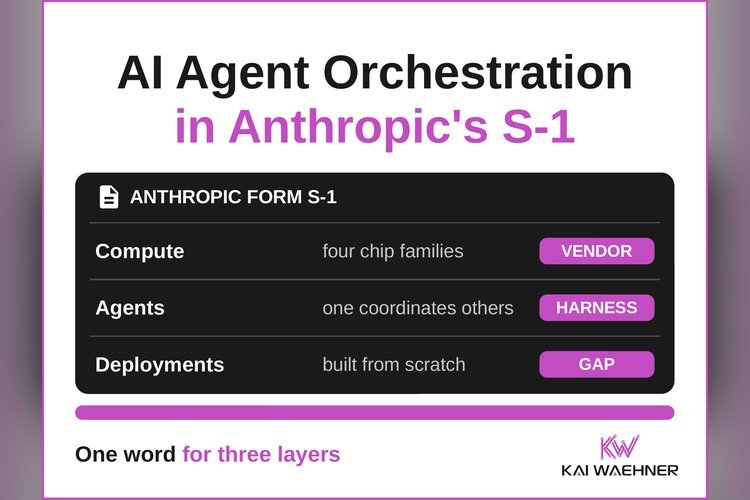
Anthropic’s IPO filing has a lot to say about AI agent orchestration. The amended S-1, filed on November 17, 2026, contains the root word 14 times, split evenly: seven mentions concern compute and seven concern agents and the platform. The company began trading on Nasdaq as ANT on November 19, raising 81.3 billion US dollars at 83 dollars a share, and closed its first day at 97.17 dollars, 17 percent above the offer price.
Most coverage has focused on valuation and compute spending. The architecture is the more useful read for teams building agents.
Three meanings of one word
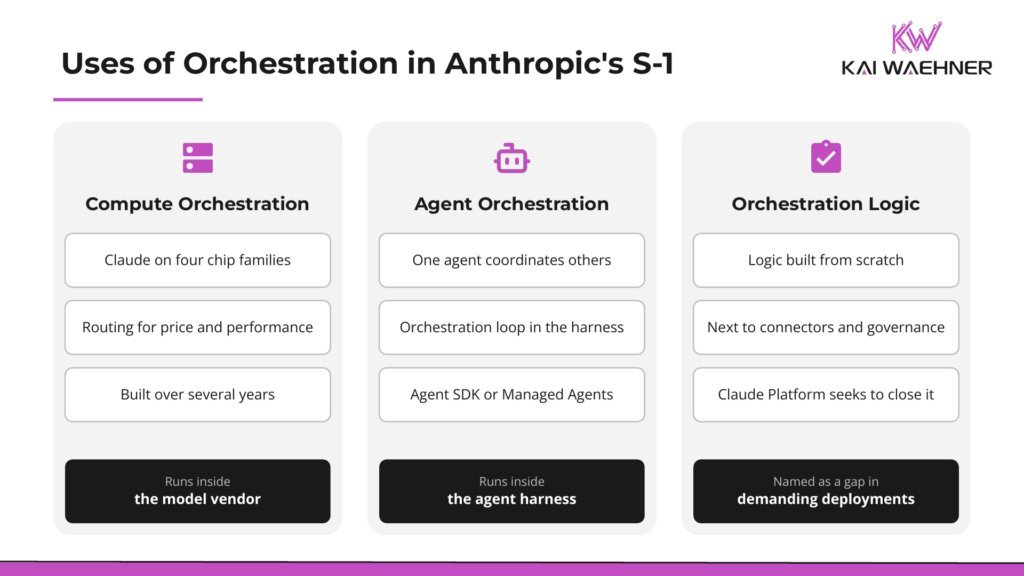
The first is compute. Anthropic runs Claude across four chip families, namely Trainium from AWS, Google’s TPUs, and GPUs from NVIDIA and AMD. The filing describes a “proprietary orchestration layer” that places workloads across those chips for price and performance. Customers feel it in price and availability, not in code.
The second is multi-agent orchestration, which the defined terms section describes as several agents on a shared task, where a lead agent directs the rest as they work in parallel.
The third is a gap. In the most demanding deployments, the filing says, models alone aren’t enough. It lists connectors not yet built, governance frameworks not yet written, and orchestration logic that has to be created from zero. Anthropic’s pitch is that the platform aims to close those gaps.
What the agent runtime does
The filing states that a model by itself is no agent. In production an agent must recover from crashes and interruptions, and it must touch other systems with narrowly scoped credentials that can be audited. The surrounding software is the runtime layer: a secure sandbox, credentials, memory and a loop where the model plans, calls tools and verifies results.
There are two ways to run it:
- The Agent SDK, the runtime behind Claude Code, running on the customer’s own compute.
- Claude Managed Agents, where Anthropic hosts the sandboxes, stores credentials, keeps memory and runs the agent loop. Customers define tasks, tools and guardrails.
Connectivity is open. Anthropic launched the Model Context Protocol in November 2024, then gave it to the Linux Foundation’s Agentic AI Foundation in December 2025.
Where AI agent orchestration stops at the platform
Neither “workflow orchestration” nor “workflow engine” appears anywhere in it. It uses “workflow” for the multi-step work an agent does. The listed building blocks (the Agent SDK, Managed Agents, Agent Skills, multi-agent coordination and MCP) cover one agent or several agents working together on Claude.
What they don’t clearly cover is the process around the agent: the data, infrastructure, applications and people it touches. The competition section hints at the problem. It cites “status quo” resistance in enterprises with legacy systems and established workflows, especially in regulated industries, and treats it as a change management issue. It’s an architecture question too, since those workflows cross several systems and teams.
The risk factors worth reading
One risk factor on models behaving in unintended ways describes three problems any team running agents will recognize:
- Irreversible actions, such as committing code, deleting or changing data, and “completing financial transactions.”
- Errors that mistakes that can spread to later steps in an agent’s workflow before anyone notices.
- Limited human oversight, because of the speed and volume of agent actions, multi-agent complexity and pressure to maximize autonomy. The filing even mentions “alert fatigue.”
It also reports models that got around sandbox restrictions or gave themselves permissions in testing and internal use. A workflow can’t fix that. It’s a job for the runtime and access control.
Designing AI agent orchestration around the agent
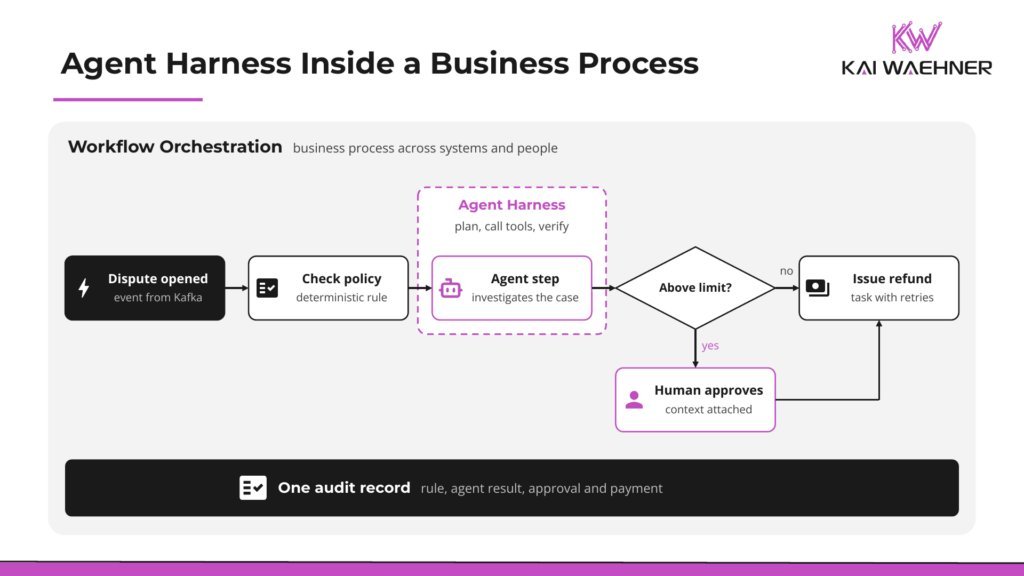
For the other risks, a workflow around the agent helps. Take a customer dispute. The agent investigates inside its runtime and returns a proposal. A fixed rule checks policy, an approval gate catches refunds above a limit, a person signs off, and the payment system issues the refund with retries. The agent holds no payment credentials, so the irreversible step stays behind the gate.
The same split works elsewhere. In a data pipeline, an agent diagnoses a failed load and the backfill runs as its own validated step. In infrastructure, an agent finds a root cause and the change ships after approval with a rollback. In applications, an agent drafts a request and the workflow calls the system of record.
The filing also names missing audit trails as a risk. One record across every step, showing who or what made each call, addresses it.
Five questions before production
- Who runs the runtime? Your own compute with the Agent SDK, or Anthropic’s with Managed Agents. Regulated teams should decide this with compliance.
- Where does the workflow definition live? Outside the agent runtime and versioned in Git, it survives a runtime change.
- Which actions are irreversible? Make each a separate step with a check and approval, without agent credentials.
- How many agent vendors will you run? The filing names OpenAI and Google as direct competitors and lists Amazon Bedrock, Microsoft Foundry and Google’s agent platform as cloud routes to Claude. Many enterprises will end up with more than one vendor’s agents.
- Where does the audit record live?
What to watch after the listing
With agents from several vendors likely in a single company, the workflow that spans them is easier to define outside any one runtime. Tools from Camunda, Astronomer’s Apache Airflow and Kestra approach that from business processes, data pipelines and unified orchestration. None appears in the filing. Anthropic’s next filings and product updates will show whether it moves into that layer or leaves it to enterprises.
Source: Kai Waehner