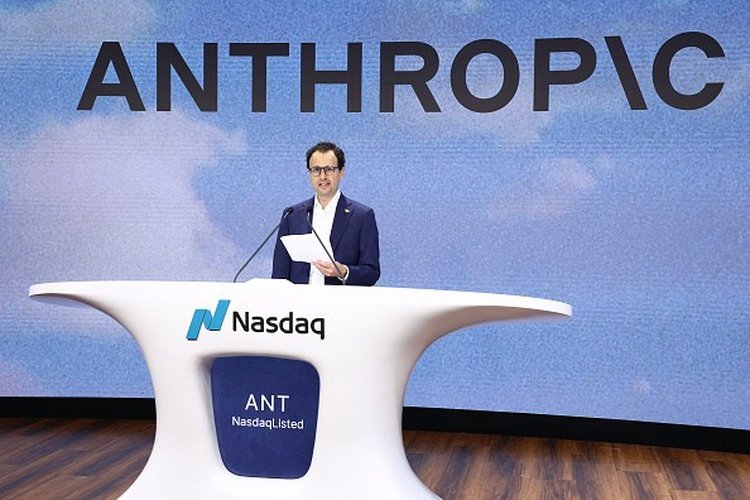
The Anthropic IPO went live on Thursday, with the company making its Nasdaq debut in what is described as the largest public offering in history. Before the opening bell, CEO Dario Amodei used his speech to promise that the company will slow down its AI work whenever safety demands it, whatever pressure it faces from investors or politicians.
He read the remarks from a printed copy. The message was blunt: Anthropic’s AI systems must “remain under human control.”
A personal origin story for the company
Amodei opened with why he and his co-founders started Anthropic. He said they wanted to build powerful technology for the benefit of humankind, and he tied that to a loss in his own family. He and his sister Daniela, who co-founded the company, lost their father to an illness that became curable only a few years later.
Amodei began his career in biology, hoping to bring future cures closer. In the lab he saw how complicated disease research is, and he pointed out that many of the tools scientists now rely on, such as gene editing, gene synthesis and methods for controlling brain cells with light, began as ideas before they became instruments.
He argued that human intelligence has already pushed plague, smallpox and polio into history for most of the world. Other diseases still move too slowly toward treatment. Going from a good idea to an approved therapy can take decades, he said, and the first CRISPR-based treatment came many years after the repeating DNA pattern behind it was first noticed. In his words, there are too few scientists with too little time.
What Amodei says Claude can do in medicine
Amodei said researchers working on protein folding, drug design, cancer genetics and clinical trial administration are finding that Claude lets them finish work in a fraction of the time it took a couple of years ago. He believes sufficiently powerful AI, working alongside humans, could compress a century of scientific and medical progress into a decade.
He kept the claim in check. At this stage, he said, the company only has early results, and experiments and clinical trials will still take time. He expects AI to speed those slow processes up substantially, but he did not promise a date for any cure.
Medicine was his lead example, though he said Claude has many other uses. Customers include large companies, nonprofits and individuals. Amodei listed economic growth, poverty reduction, defending democratic societies and even smoother DMV services as areas where they are putting the technology to work.
The risks he named
Amodei said Anthropic has always been open about the dangers. He listed misuse by individuals or nation-states, economic disruption, and losing control of AI systems. His line was that the company discusses these risks because it considers them avoidable, not because it thinks they are inevitable.
He drew a sharp contrast between a future in which developers pay little attention to safety and one in which they are obsessed with it. He said that focus has been part of Anthropic from the start. As examples he cited safeguards against biological and cyber risks, alignment training and testing, and research that looks inside models to understand and steer their behavior.
Then came the commitment that drew the most attention. Amodei said Anthropic will pace the training and deployment of its AI systems and take as long as needed to be confident they are safe and will stay under human control. He added that the company will not bend to business or political pressure.
He also admitted that the hardest part is still ahead. The company’s engineers and researchers, he said, will need to spend even more time double and triple checking that its systems are safe.
The race to the top
Amodei argued that the IPO leaves Anthropic in a stronger financial position, which he said only firms up its resolve. If the company can make the right safety choices and still build a very successful business, he said, other firms will be encouraged to follow. He calls that dynamic a race to the top.
In that picture, it matters less which company has the best model, because everyone wins when everyone builds safely. Anthropic hopes to lead from the front, he said, but the stated goal is a better industry whether Anthropic is ahead or behind at any given moment.
Daniela Amodei repeated the message in a television interview the same day. She said the risks are real but the promise of AI is also “incredible,” and that the company was founded on the idea that it is responsible for mitigating those risks. She said Anthropic has done an incredible job so far, while acknowledging more work remains.
How this fits with his earlier warnings
The speech was consistent with positions Dario Amodei has taken before. In September he proposed a plan to pace AI development. It included coordinating with other leading labs on safety standards and placing evaluators from outside organizations inside companies to verify they keep their safety promises.
OpenAI CEO Sam Altman, Google DeepMind chief Demis Hassabis and xAI owner Elon Musk said they agreed with his position. Few concrete commitments have followed, though.
What to watch after the listing
The Anthropic IPO means public markets now get a say. Shareholders will want growth, and Anthropic has put in writing, on the day it listed, that it will slow down when safety requires. Whether it can honor both is the practical test of the Anthropic IPO.
Look for two things. One is whether other major labs match the safety standards and outside evaluation that Amodei proposed in September. The other is whether Anthropic keeps its release schedule flexible once quarterly results are public. Amodei has made the pledge in front of investors, so any delay or a launch that goes ahead too fast will be measured against it.
Source: TechCrunch