An analysis of vendor disclosures from more than 40,000 companies shows what the typical AI stack looks like in late 2026. Between 16 October and 13 November 2026, model routers and gateways grew fastest, while Anthropic and OpenAI stayed the most named model providers.
Growth is measured as the net number of new companies listing a vendor, divided by the vendor’s count at the start. With only about a month of data, the figures are a snapshot.
Anthropic and OpenAI lead, and most companies use more than one
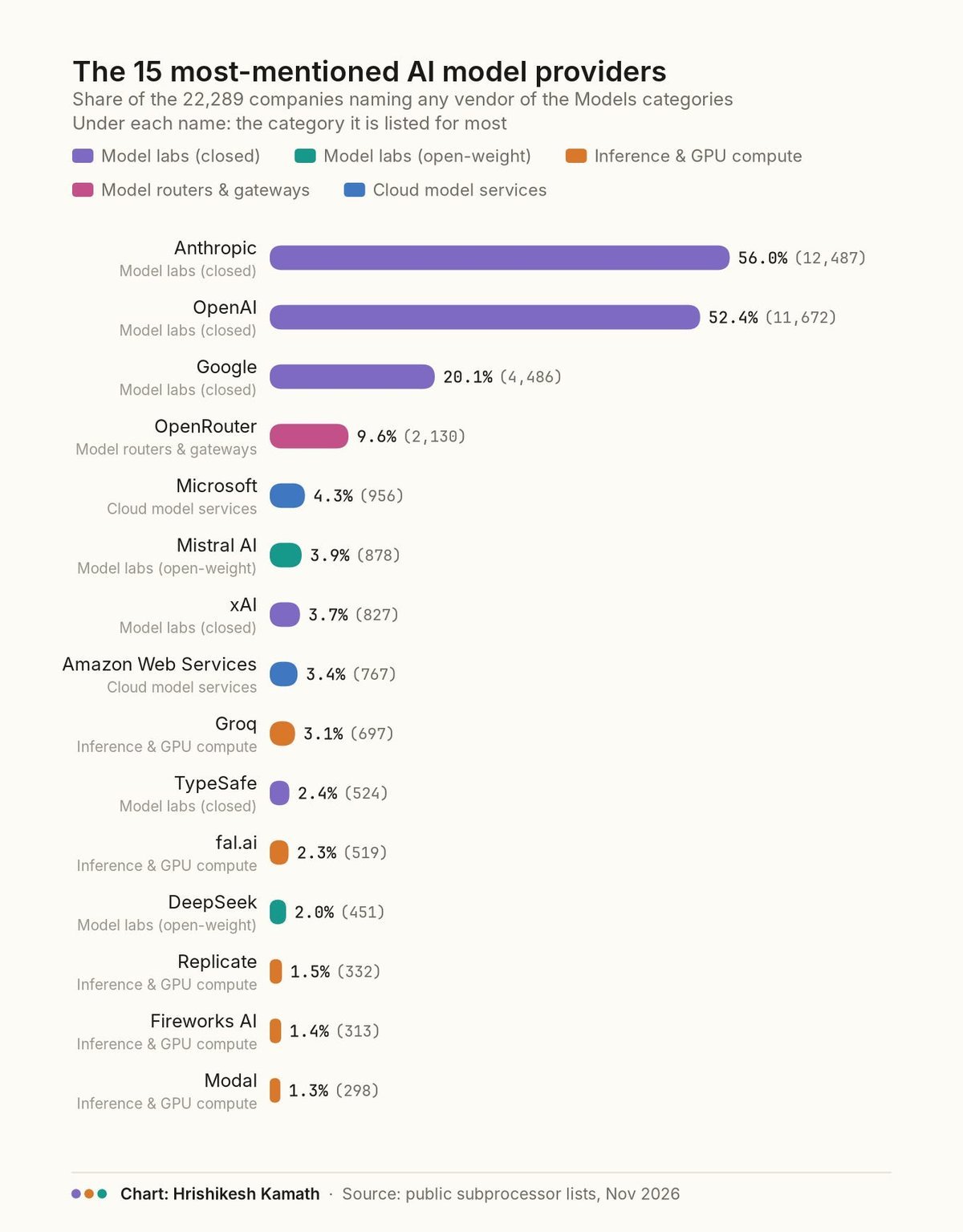
The study counts a wide set of vendors as model providers: labs, routers, cloud model services and GPU compute firms. Labs with closed models get named most. Open-weight labs and inference hosts trail.
Multi-vendor setups are common. Nearly half of the companies naming an AI model provider, 44.8%, list two or more.
AWS and Microsoft land in the cloud model services bucket when a company names Bedrock or Azure OpenAI. Both run other labs’ models, among them closed ones from OpenAI and Anthropic, on their own servers. A few mentions may refer to the clouds’ in-house models.
Routers are growing fastest
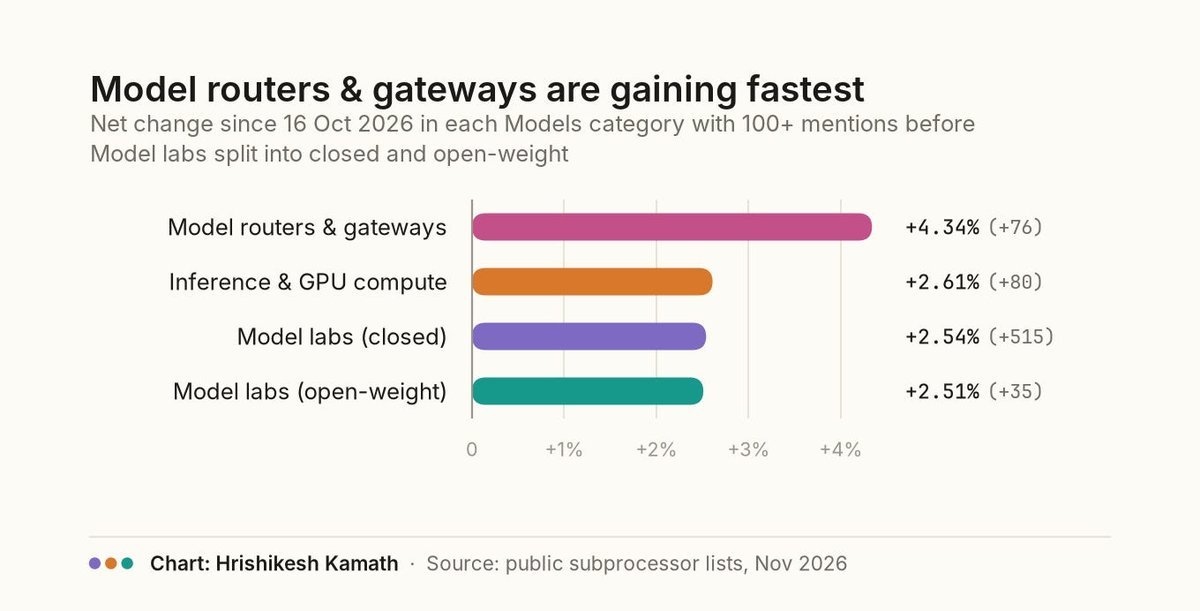
Inference and GPU compute vendors show up on slightly more company lists than routers. Routers are climbing quicker, though, and OpenRouter accounts for most of the jump.
One API gives access to models from many labs or hosts, so swapping providers or mixing models takes less work.
Growth in routers and inference providers hints that open-weight models are gaining ground. OpenRouter’s own usage data agrees, although it tracks tokens on its platform, not companies in this dataset. The lists can’t show which models a router serves, or what a company runs in-house. That makes the AI stack picture incomplete.
Chinese model providers are small but not absent
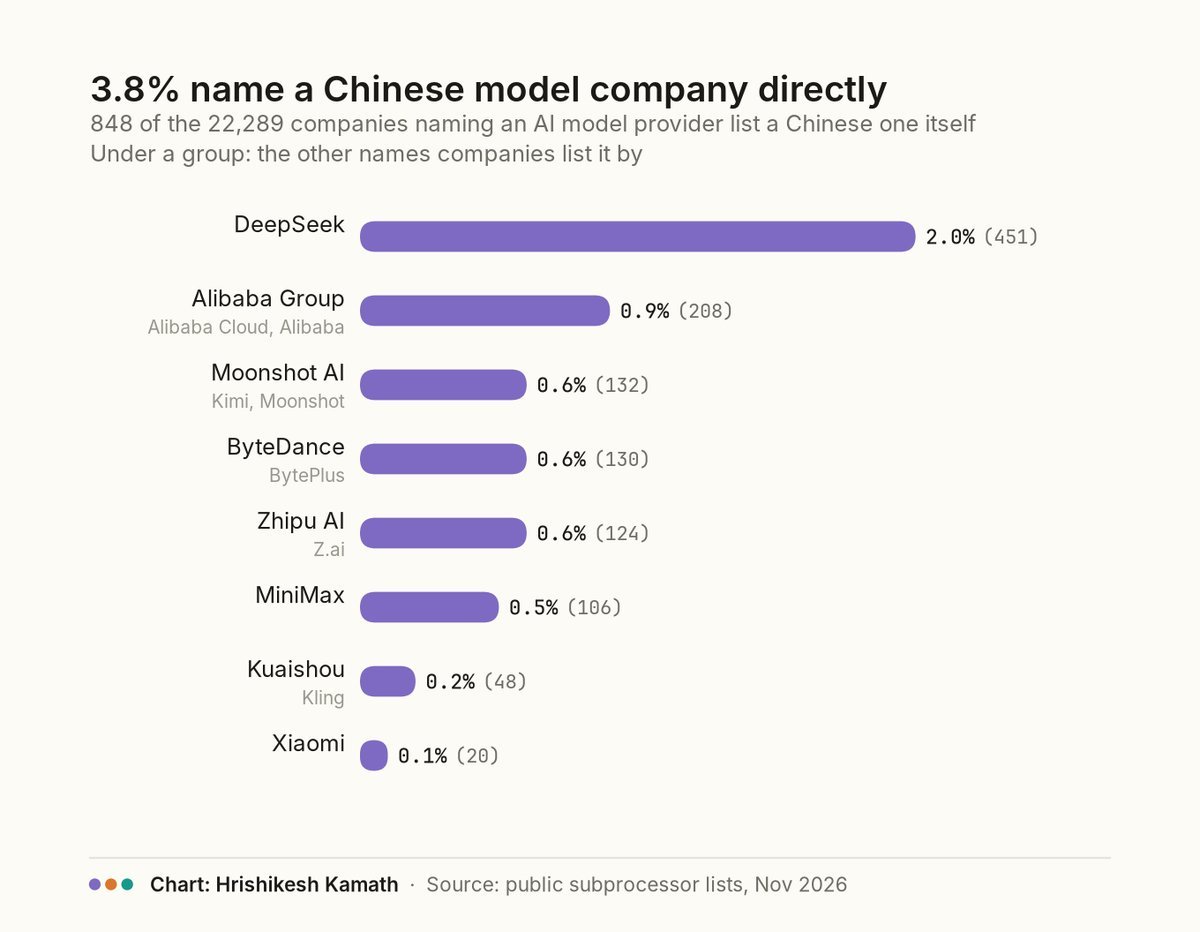
Direct mentions of Chinese model providers are rare, but more common than the analyst expected. DeepSeek is on top. Most companies naming one also list a non-Chinese provider.
Actual use is probably higher. A Chinese model served by a US host or router, or run on GPUs rented from Modal or RunPod, may never show up in a disclosure.
Their growth rate is close to everyone else’s, which says little. The topic still matters in the US, where sending data to mainland China is a hot political issue. The government wants to publicly shame companies that use Chinese models, even self-hosted ones or ones reached through US inference providers.
Search APIs hold their ground
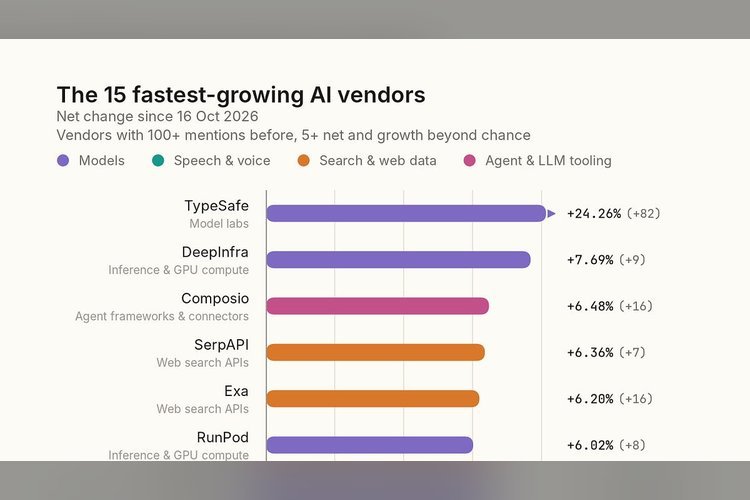
TypeSafe posted the biggest gain of any single vendor. SerpApi and Serper grew too, even with agent-focused search services like Exa, Parallel and Tavily on the rise. Older search APIs clearly still have a role in the AI stack.
A company can sit in several categories, so counts overlap. Vendors that sell broad suites were hard to place.
The ten fastest-growing categories
Most of the fastest-growing software categories were AI-related. The top ten:
- Agent sandboxes: isolated spaces where agents execute their own code
- Web search APIs that apps and agents query for pages and text
- Agent frameworks and connectors, including SDKs, memory and inboxes
- Model routers and gateways that send requests to different labs, fail over when one goes down and consolidate billing
- Web scraping for agents
- Voice generation from text
- LLM observability and evals: logging, debugging and quality testing
- Meeting notetakers
- Inference and GPU compute
- Speech-to-text
Agent frameworks are probably undercounted, since open-source ones run inside a company’s own code and only hosted services get disclosed. Edge cases exist too: Recall.ai serves notetaker products but supplies meeting-data infrastructure instead of taking notes. Groq among speech-to-text players is another oddity.
What this means for teams choosing vendors
The data points to a market where few companies bet on a single lab. With 44.8% naming two or more providers, a router or gateway that forwards requests, switches when a service fails and bills in one place fits how many teams already work.
It also suggests that newer categories, such as agent sandboxes and web scraping for agents, are being adopted quickly alongside the core model providers. Teams building agents should expect to assemble several of these pieces rather than buy one product.
What the data can’t tell you
Use cases were grouped by spotting terms like chatbots, document analysis or writing in vendor descriptions. Some firms just write “AI services,” so only described uses count.
For the AI stack of AI-native companies specifically, DeployGraph by nikunjk covers that group.
Source: kamathhrishi.substack.com