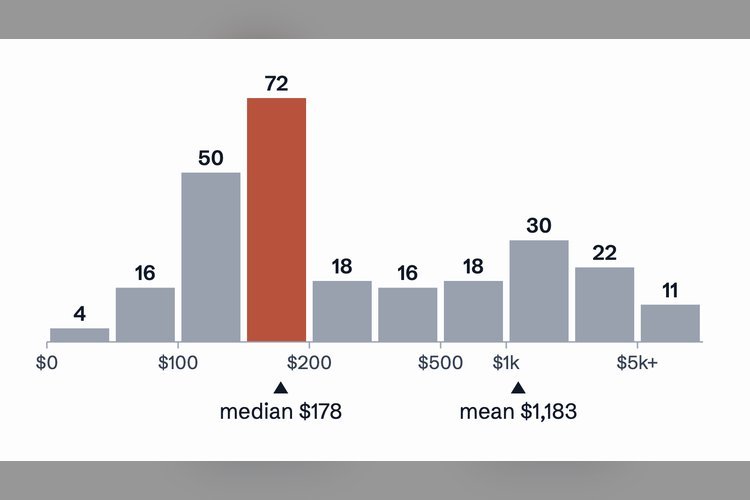
Companies that call themselves AI-native spend anywhere from about $100 a month per engineer to more than $10,000 for the heaviest users. A workable starting point for AI spend per engineer is roughly $200 a month on seat-based plans or $1,000 on token-based plans, then adjusted with real usage data.
The spread exists because AI coding moved fast. In Stack Overflow’s 2026 Developer Survey, 83% of respondents used at least one AI tool and 65.9% used coding assistants or agents.
What happened when budgets had no ceiling
Early in 2026, several large tech companies told teams to use AI at full speed with no spending cap. At Meta, an internal leaderboard called “Claudeonomics” ranked more than 85,000 employees by tokens burned, with top titles such as “Session Immortal” and “Token Legend.” Staff used 60 trillion tokens in 30 days. Engineers described much of it as waste, and the board came down soon after it leaked.
Uber took a less extreme path and still burned through its 2026 budget by April. It now caps usage at $1,500 per month per person.
How limits are set today
Small startups mostly buy seats, such as premium Claude Team seats. Subsidies make those plans more generous than API pricing: a $100 premium seat can behave like a $1,000-a-month limit on an enterprise plan. Buying seats and moving on is the most common strategy at that size.
Companies with 150 or more seats, or compliance needs, usually pay per token. Most set caps. Some are high enough only to stop runaway bills, and others bite. Limits often differ by group, team or level, and they tend to come from gut feel, past spend or budget pressure instead of a cost-benefit calculation.
The more careful companies tune limits from usage data and review token spend daily or weekly. They treat waste as a smaller problem than poor use, though they react to it. One sales employee burned $12,000 in a week on a dubious project, and that triggered tighter rules.
They also raise budgets quickly. Someone who hits a limit can get a temporary override or move up a tier, and the biggest spenders are often the most productive people.
Cisco’s no-cap exception
Cisco gave 27-year-old Padmanabhan Krishnamurthy unlimited AI tokens. President and chief product officer Jeetu Patel found him five levels down the organization. The goal is to refactor 98% of Cisco’s legacy code in 24 months with a two-person team, and Krishnamurthy gave himself four weeks to prove the approach works.
Unlimited tokens can pay off for chosen projects. As a company-wide mandate they don’t.
Measuring what the money buys
Pull requests and delivery metrics are rising. Jellyfish data shows the average number of pull requests per engineer per week going from 1.36 to 2.9, and traditional DORA measures such as time from bug report to production fix have improved.
Modernization work shows the clearest payoff. Airbnb used AI to migrate its UI tests in six weeks, a job that would have taken a year and a half.
The link to company-wide financial results is weaker. Uber’s COO has said he hasn’t yet seen a direct connection between AI use and higher efficiency. Jobs data points the other way: open frontend engineering roles are down 51% in a year, with drops in mobile development, design and UX research too, which suggests companies can ship more with leaner teams.
Standards are still forming. The Tokenomics Foundation has proposed a Value Classification, and there are proposals to label agent sessions with outcomes in OpenTelemetry and the FOCUS specification.
What works and what doesn’t
A fixed per-head budget can lock AI into an add-on role. Some organizations still work as if it were the Sonnet 3.7 era and skip agent swarms, goals and tight feedback loops.
- Prevent waste with limits or usage alerts.
- Make higher limits quick to get, so a day of work doesn’t wait three weeks on three approvals.
- Fund expensive projects with high returns, such as a tool that reads log lines and code changes to handle most support escalations, even at several thousand dollars.
Underuse is the bigger problem at many companies. People send short prompts and wait a few minutes for each one, instead of writing one longer, specific instruction. Voice dictation helps. Tokens remain cheap next to the alternatives, and most teams are well behind what’s possible.
Internal tooling is clunky. The better setups use Slack automation for weekly recaps and threshold alerts, and raising a limit should take at most one Slack interaction.
A budgeting plan for the next quarter
Start at $200 per engineer per month on seat plans or $1,000 on token plans, and revisit it regularly. Keep approval cycles short for work that adds value, and back anyone who shows a compelling demo.
High-token projects deserve the same questions as any budget line. Are they on target? Is there a cheaper alternative by a factor of ten? How well is the value measured? Many expensive projects will pass that test.
Source: Quesma