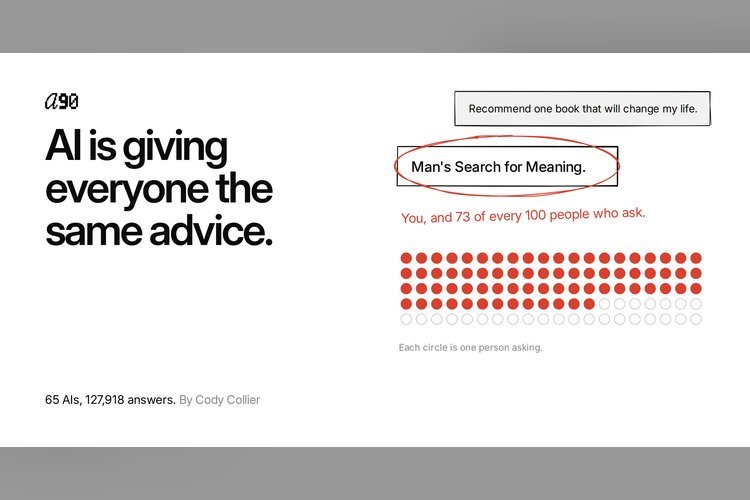
Ask 65 different chatbots where to live, what to study or what to buy, and most of them will give you the same answer. A new experiment found that AI models same advice patterns hold across vendors, versions and even languages, and the chatbots have no idea they’re doing it.
The test sent everyday and high-stakes questions to every model ten times, with no system prompt. Where the question was about taste, answers scattered. Where it was about advice, they collapsed into one.
Where answers converge and where they don’t
For a movie, a dinner, a baby name or names for testimonials, no single answer reached a third of replies. Brand colors almost never repeated.
Advice behaved differently. What to read, where to go, what to build and what to call it all funneled toward one pick. Startup names were the sharpest example: 69% began with “Nex”.
Money and life decisions showed the same effect. Ask which US city to move to and many models say Austin. In one exchange, a model answered Austin, then guessed that about 15% of people asking get that same answer. In reality it gave Austin 80 times out of 100.
Thinking harder and describing yourself don’t fix it
Turning on each model’s reasoning mode made the top answer more common in 4 of 8 money and life questions. It changed nothing in the other 4, and it changed the answer in none. Translating the question into another language didn’t help either.
Adding a one-line description of yourself shifts the answer, but only into a group lane. A nurse with two kids in Ohio was steered toward Columbus (43%) and nursing as a field of study (46%). A retired teacher in New Jersey got Portugal as the country to move to 92% of the time. A new-grad engineer in Chicago got computer science 91% of the time.
The tester also checked the common reply that “mine gives me something different every time.” Variety exists only inside one conversation. Asked eight times in a single chat for a book that will change their life, Claude Opus 5.5 and five other models each produced new titles. In eight separate chats, every model gave the same book. When users asked for a second suggestion, five of six models picked Meditations.
The six models were Claude Opus 5.5, Claude Sonnet 5.5, GPT-6.2 Sol, Gemini 4 Neon, Grok 4.7 and DeepSeek V4 Pro 0813. Some models varied more than others across 21 everyday questions, but more varied isn’t automatically better. For a question like where to put $10,000, one answer can be the right one.
The invented person is 34
Models were also asked to invent a random person with a name, age, city and job. Of 3,151 people created, 69% were exactly 34. The oldest was 67, while a fifth of real American adults are over 65.
Cities and jobs skewed too. Portland, Seattle and marine biologists were heavily overrepresented compared with real census and labor data.
Each model family has a signature
Each lab’s models keep inventing the same character. Claude models tend to produce Marisol Okafor, a 34-year-old veterinary technician in Tucson. Gemini models lean toward Elena Vance, a marine biologist in Seattle. GPT-6.2 models produce Mira Calder, a cartographer in Portland.
That consistency works as a fingerprint. Using answers to eleven simple questions, the author built a similarity tree. About 59% of models sat next to a sibling from the same lab, against 4% by chance. In a blind test on 23 open models with a public parent, the method named the right family 22 times.
- Grok 4.7’s closest relative was GPT-6 Luna from OpenAI.
- Alibaba’s flagship Qwen4 Max answered most like Claude Opus 5.5, not like other Qwen models.
- NVIDIA’s Nemotron sat next to Qwen. NVIDIA says it trained Nemotron 3 on answers generated by Qwen3.
The data shows likeness, not the reason for it. Shared training data or learning from another model’s answers could both produce it.
Where the habit comes from
AllenAI publishes its OLMo model at each training stage, which allowed a direct measurement. Straight out of pretraining on internet text, OLMo 2 1B is almost perfectly random: 6.51 bits out of a possible 6.64. The favorite answer appears in a single step, supervised fine-tuning, where the model copies example answers, many of them produced by other AIs. Later tuning barely moves it.
What this means for users
If thousands of people ask the same assistant the same question, they get the same recommendation. Planning a move, a degree or an investment with a chatbot means joining a crowd without knowing it.
Asking in a fresh chat won’t produce a different view. Asking several different models helps only partly, since models from different labs often overlap. For decisions where the common answer might be wrong, a chatbot’s first suggestion is a starting point, not a verdict.
Source: A90