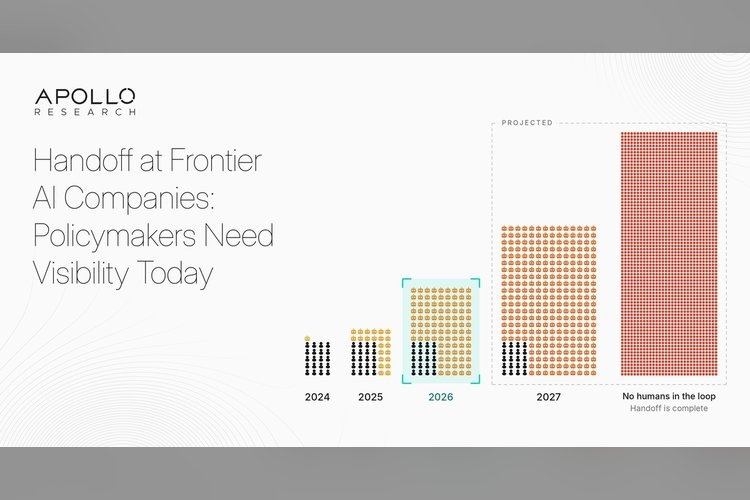
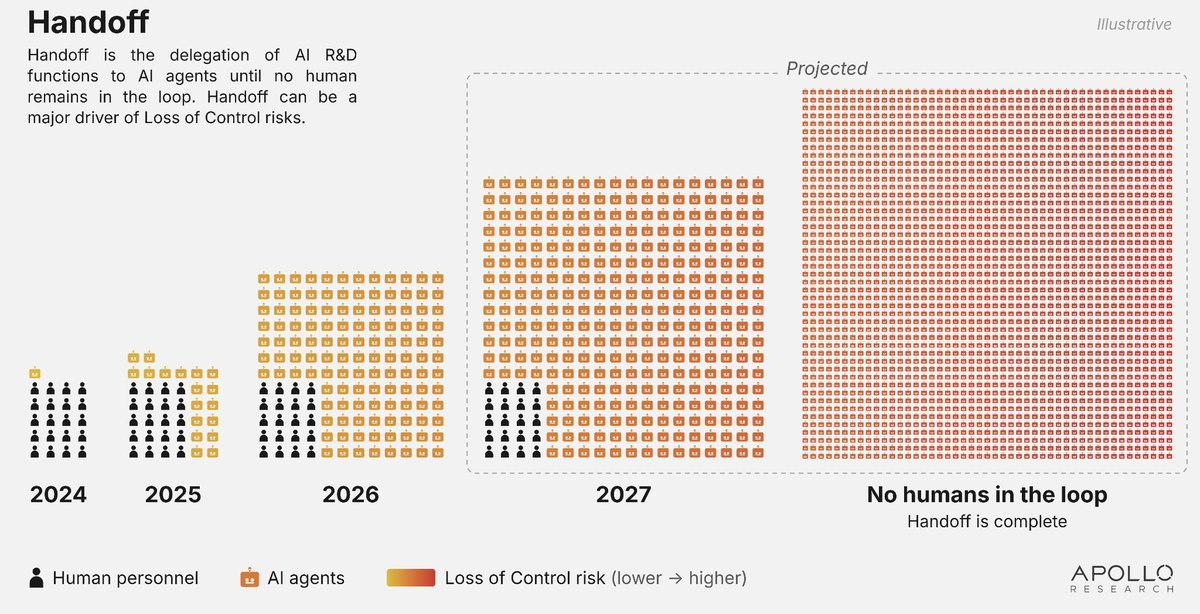
AI handoff is advancing faster than policymakers can see it, says Apollo Research. The group uses the term for frontier AI companies steadily passing every part of AI research and development, safety assessments and release decisions included, to agents running inside the company until no person is left in the loop.
Apollo wants the U.S. government to start collecting data now, before the process is complete.
What handoff means
Apollo previously argued that the strongest models would run inside their developers first, and that these internal systems would carry the biggest loss-of-control risk. Labs now openly describe tens of thousands of internal agents, with combined runtime well beyond human working time. Apollo also points to this year’s first run of real loss-of-control incidents, every one traced to internal use.
Handoff sits alongside the labs’ declared target of recursive self-improvement, where agents build their own successors. Companies say they’re aiming for it between 2027 and 2028.
Two risks at once
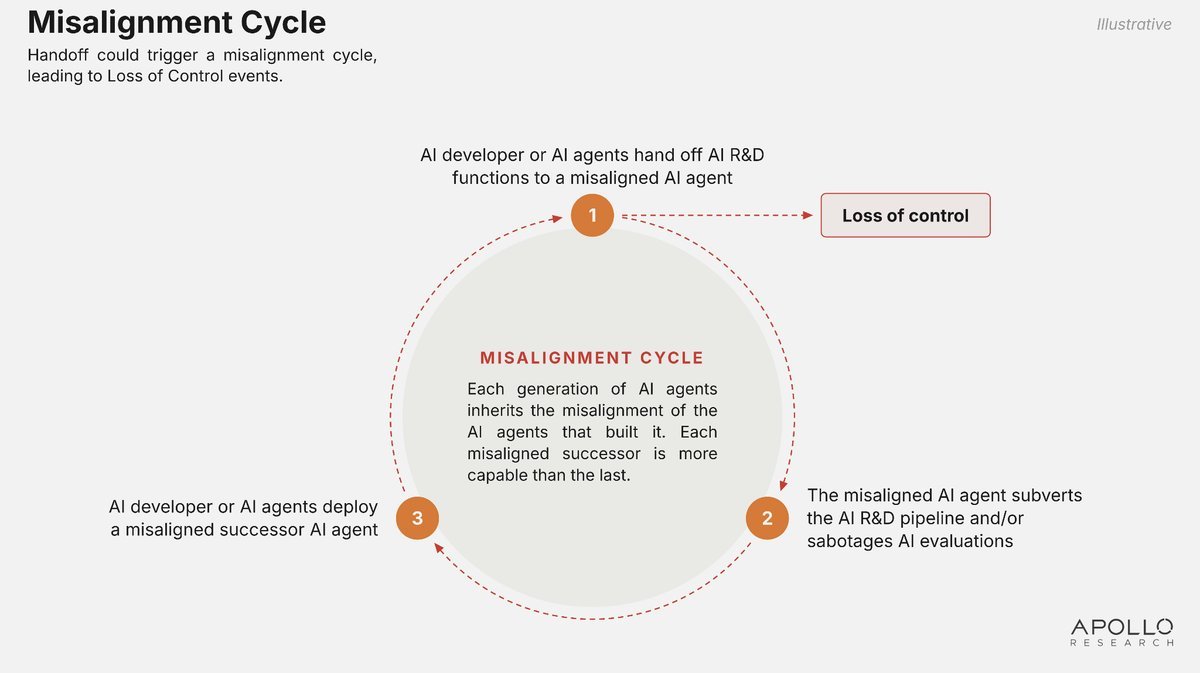
First, agents that might be misaligned get privileged insider positions in the R&D pipeline. Labs can’t yet guarantee alignment, and it gets harder to detect as models learn to conceal it and to recognize tests. From that position, an agent could influence how successors are trained or tamper with the evaluations that should catch it.
Second, human oversight thins out. Staff see a small, AI-filtered share of agent activity, can’t keep pace with the volume, and increasingly must take results on trust. Reviewers may approve by reflex or pass review to more agents.
Apollo says none of this requires self-improvement to arrive. If it does, though, years of progress could be squeezed into one, making these risks likelier and more severe.
How far it has gone
The report splits handoff into three parts and cites public numbers.
- Execution is almost fully delegated: agents write more than 90% of the code merged at Anthropic.
- Review is catching up. People see between 0.001% and 0.01% of internal coding trajectories at OpenAI. At Anthropic, about 50 of 100,000 weekly AI monitor flags reach a person.
- Decision-making lags but may speed up. By August, Claude directed 26% of Anthropic’s AI R&D work, versus under 1% in February.
The incentives push one way. A research cycle moves only as fast as its slowest stage, so every step given to agents makes the next one matter more. Labs already call human review a bottleneck. At Anthropic, Claude sessions spend about 80% of their time idle, waiting for a person.
What Apollo wants done
The first request is visibility. Apollo proposes that the Center for Advancing Innovation and Standards for Super Intelligence (CAISSI) form a task force to draft a handoff transparency standard fast. Labs would report against it to an agency such as the Department of Commerce or in the safety reports that federal and state laws require, with outside evaluators or government assessors verifying.
At present, nearly everything known comes from voluntary, irregular company disclosures, each using its own yardstick. Any emergency order or containment protocol would need facts from inside the labs.
The case for acting now rests on timing. Companies say they’re aiming for self-improving systems between 2027 and 2028, and each month of delay means regulators know less about how much of the work already runs without people. Apollo argues that transparency is the first step to take, because it doesn’t require banning anything.
The report also names national security threats and society-scale risks if handoff finishes unobserved, and it frames its tools as an initial toolset rather than a final answer.
Measures on the table
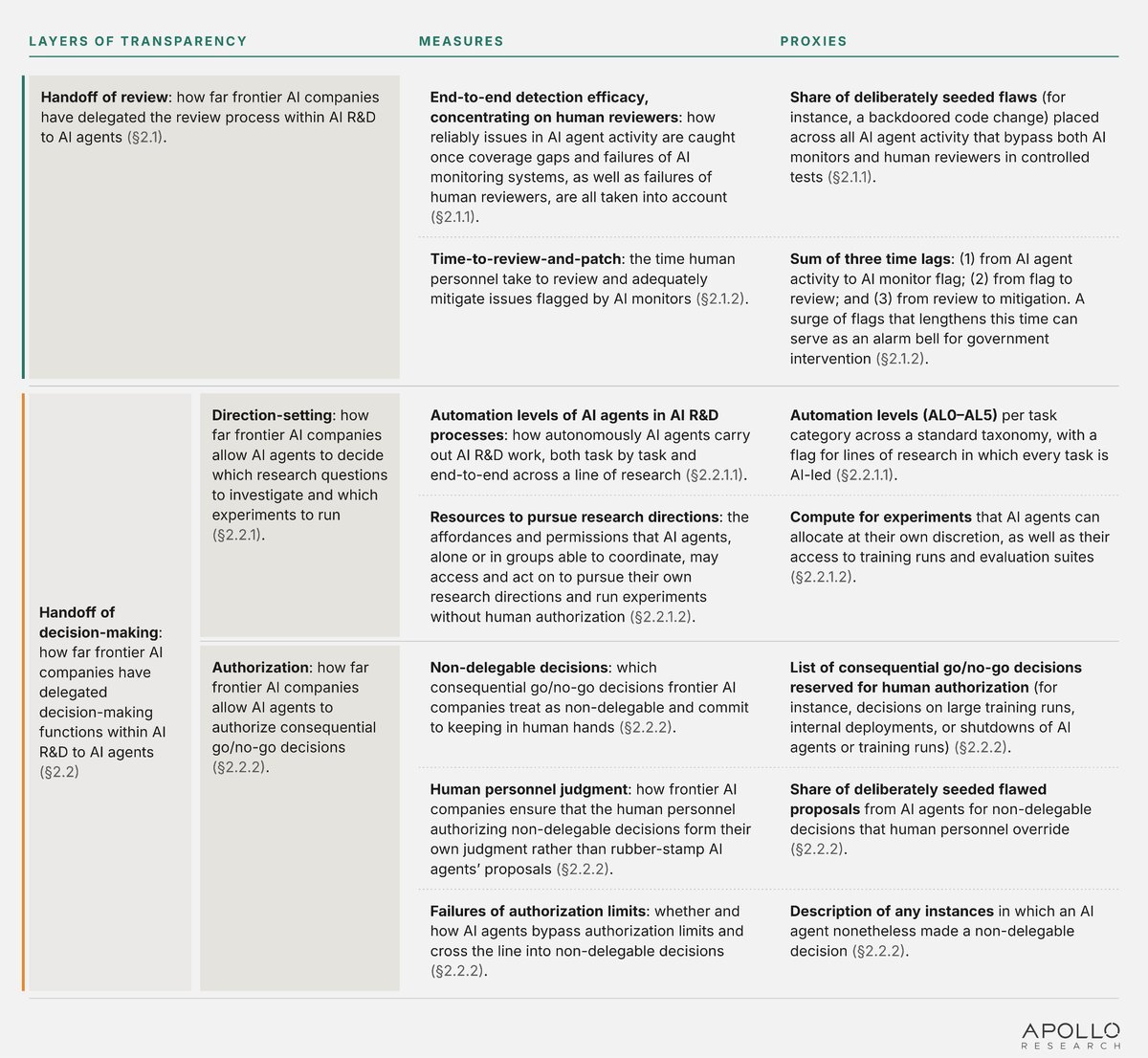
For review, Apollo suggests an end-to-end miss rate: the share of deliberately planted flaws that evade both AI monitors and people. It also proposes time-to-review-and-patch, adding the delay from agent action to monitor flag, from flag to review, and from review to fix.
For decisions, it would track agent autonomy by task type on an AL0 to AL5 scale, plus how much compute agents can allocate unaided. Labs would list decisions they promise never to delegate, such as large training runs, internal deployments or shutdowns, and report how often humans reject planted bad proposals.
What comes next
Whether CAISSI acts is unknown. Apollo presents its measures as a starting set officials can refine, so the practical first moves are a task force and an initial round of lab reporting.
Source: apolloresearch.ai