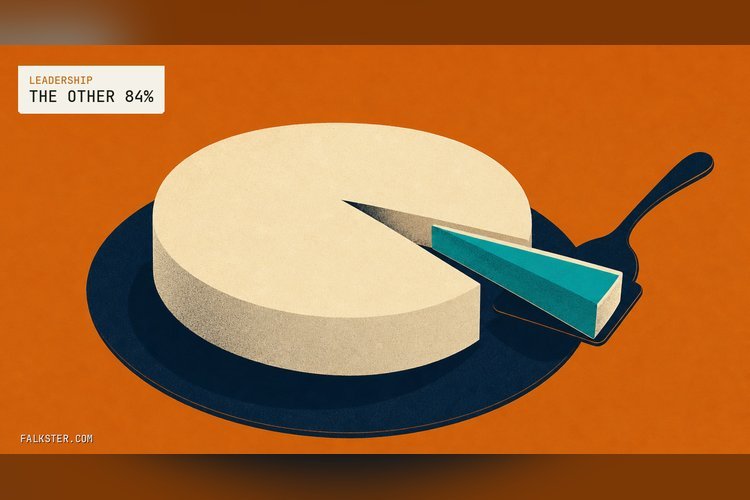
Plenty of companies bought AI coding assistants hoping to ship faster. Many now report busy tools and unchanged delivery. Atlassian, which makes Jira, has figures that show why: AI coding output improves by roughly 10% and then flattens, even when AI is involved in nearly every code change.
The company’s senior group product manager for AI, Matthew Canham, shared the numbers on November 23, 2026. They cover about 6,000 Atlassian engineers working with AI agents.
Why gains stop at 10%
Data from DX, a firm that studies developer workflows, puts the improvement in team output at about 10%. It stays there as AI-assisted changes approach 100% of the total.
The explanation is arithmetic. Developers spend around 16% of their working time actually writing code. Planning, review and handoffs fill the other 84%. Making the 16% faster leaves most of the day untouched.
Atlassian’s own team survey adds a human angle. Just 48% of executives said AI had improved how people collaborate.
A caveat applies. These are a vendor’s numbers about its own products, and the DX report and survey haven’t been checked independently.
The work around the code
Atlassian’s improvements came from four places other than typing code:
- Planning: product, design and engineering draft the plan with an agent that has access to the codebase and past work. It proposes which jobs fit a person and which fit an agent. The team makes the call.
- Requests: a discussion in a chat thread turns directly into a work item, keeping its rationale and unusual cases.
- Routing: low-risk changes go to an agent right away, while larger ones get a summary and a human first.
- Review: an agent compares every change with team standards and with the original request.
Atlassian says faster coding alone was never going to be enough, and this list backs that up.
Why product teams should care
Each of those changes answers a product question. What is the work? Why does it matter? Who should take it? What counts as done?
When the answers are vague, work stalls. An engineer or an agent starts, finds a gap, and waits for someone to fill it. A large share of that 84% is this kind of waiting.
Atlassian aimed its findings at engineering leaders. They could just as easily go to a chief product officer, since the slow part of delivery now sits in preparation and decision-making. The numbers also argue against measuring cost per merged code change, which stops counting too early. Time to finish the whole work item is a fairer yardstick.
What the pattern looks like in practice
The same ceiling shows up in small setups. One writer’s agent drafts four social posts per run, which made drafting quick. Publishing stayed at one post a day, and 80 posts sat in a queue. Writing speed went up while daily output didn’t move.
That is the 16% and 84% split in miniature. Speeding up one step only helps if the step after it can absorb the extra work. In software teams, the following steps are review, approval and release, and each of them depends on people having clear instructions.
Two measurements to try
A product leader can start without any special tooling:
- Wait time: count the days between a request being written and someone starting on it.
- Rework: count how often work returned because a reason, a design or a decision was missing.
Neither lives in the code, so a coding assistant won’t change them. A request that arrives with context will.
A quick test for your own team
Take one feature your team shipped last month. Add up the days it sat waiting and compare that with the days someone spent building it. Bring both numbers to your engineering counterpart.
If waiting wins by a wide margin, your next improvement probably won’t come from a faster model. It will come from better-prepared work, and that is the bottleneck Atlassian says it spent its effort on.
Source: falkster.com