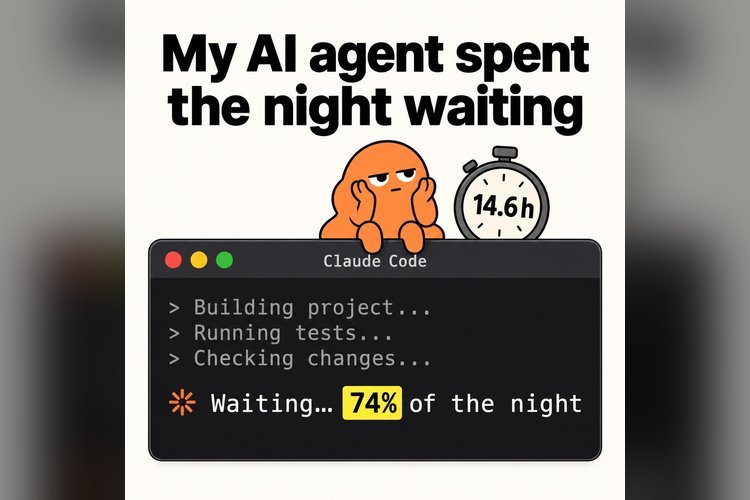
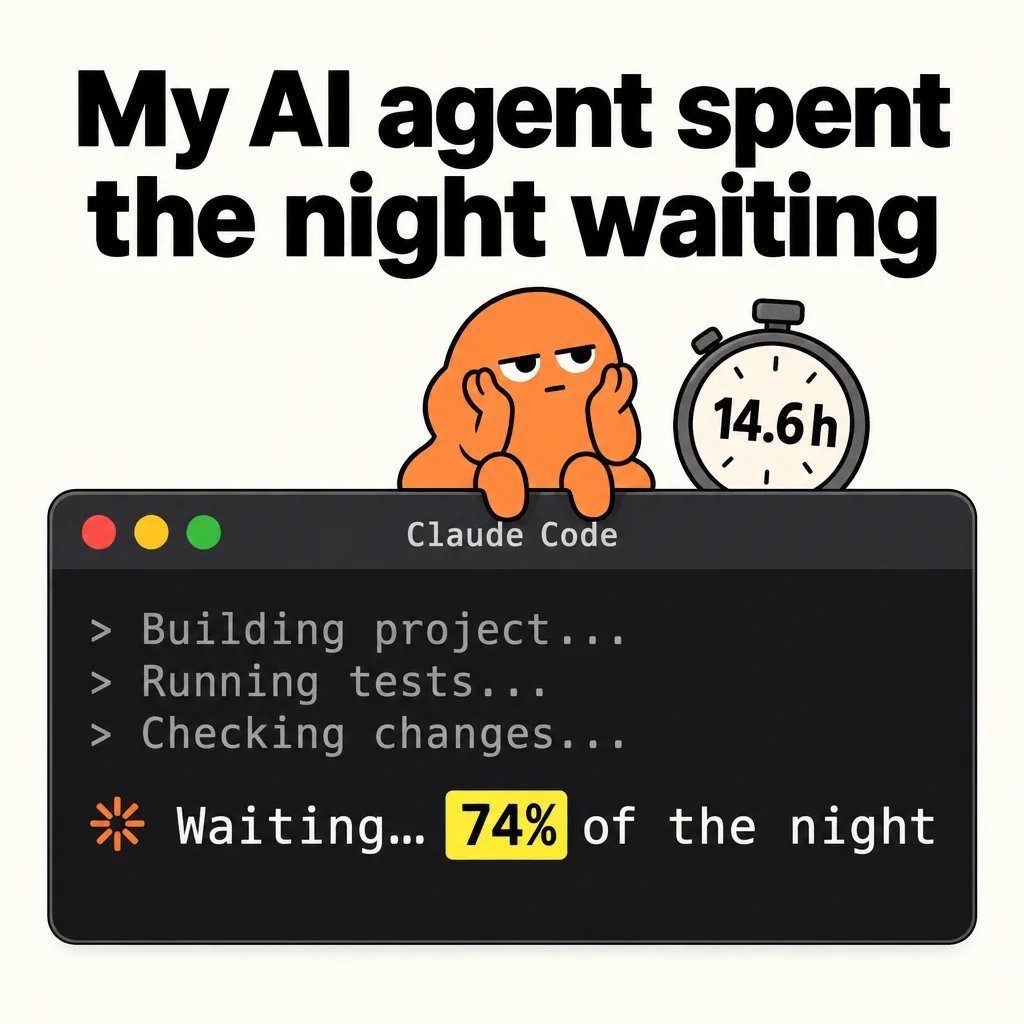
Developer Juraj Blahunka logged an overnight session where Claude Code agents added features to his iOS app, and the AI coding agents turned out to spend most of it idle. The model was active just 26% of the night. Eleven features took 14.6 hours, finished sequentially.
With a few tweaks he expects double the output next time.
How the overnight run was set up
A single Claude Code session played manager and wrote no code. It spawned a new agent per feature, and each agent followed one routine: draft a plan, get it approved, build the feature, prove it with UI tests plus a recording from the simulator, then fix the reviewers’ complaints.
Two reviewers examined every change simultaneously: a new Claude Opus agent and GPT through Codex. After that the manager merged the result and started the next feature. With no parallel work, a single agent used a single simulator all night.
To get numbers, Blahunka fed all the night’s transcripts to an analysis agent that assigned each second to a category: model time, builds, tests, waiting and so on. He allows for roughly 10% misfiling, mainly between UI tests and simulator checks.
Where the time went
The simulator ate two thirds of the night. Generating code was quick; verifying it wasn’t.
- Unit tests cost almost nothing, at 13 minutes across 47 runs.
- Agents ran individual UI test classes 191 times, which added up to 198 minutes. The complete suite ran 20 times, each taking between 6 and 15 minutes.
- Agents recorded about 73 takes to get 11 proof videos.
- Review waits averaged about 4 minutes per feature: Opus needed 2 to 5 minutes, GPT roughly 1.
- Post-review fixes consumed 289 minutes, about a third of the night.
One oversized feature, a bundle of 8 small platform items, took 241 minutes by itself, or 28% of the night. Its fix round alone outlasted three other features’ entire runs.
Reviews were worth the wait
Reviewers flagged 127 issues, of which about 36 were genuine bugs and 56 were nitpicks. Every nitpick still got a full reproduce, fix and re-prove cycle, and that’s where much of the cost came from.
The first feature in the queue reworked the UI test suite. It folded 45 tests into 12 user journeys that begin from seeded data, and dropped the runtime from 875 seconds to 375. UI tests still consumed a third of the night, because the suite ran 20 times on top of the 191 single-class runs.
Two ideas didn’t survive. Faster animations through a launch argument saved 2.1%, inside the roughly 7% variation between identical runs. Three parallel simulator clones finished in 274 seconds, but a motion test broke under load.
What Blahunka changed
He ranked the causes by minutes lost and acted on these:
- Build two features at once, each in a separate git worktree and simulator, chosen so they touch different areas of the app.
- Begin reviews the moment code is committed, during testing, so both sets of fixes happen in one round.
- Make one proof video per feature, using a committed UI test.
- Run the whole UI suite once per feature after the final commit, and only the relevant tests along the way.
- Rebuild before every test run, since one agent wasted two video takes on a stale build.
- Batch the nitpicks into a single polish pass.
The analysis projects that two simultaneous features about double a night’s output, and the remaining changes should cut 30 to 40 minutes from a typical 80-minute feature.
How to measure your own AI coding agents
Blahunka’s prompt for others is to have Claude Code read the last three days of transcripts in its projects folder and tabulate elapsed time by category, using tool call timestamps. He bets that where agents build, test or drive a browser, the model won’t be the largest share.
The lesson for teams running AI coding agents is practical. Idle time, not model speed, set the pace of this run. Faster models help less than faster test loops, and the next run will show whether his fixes hold up.
Source: Juraj Blahunka