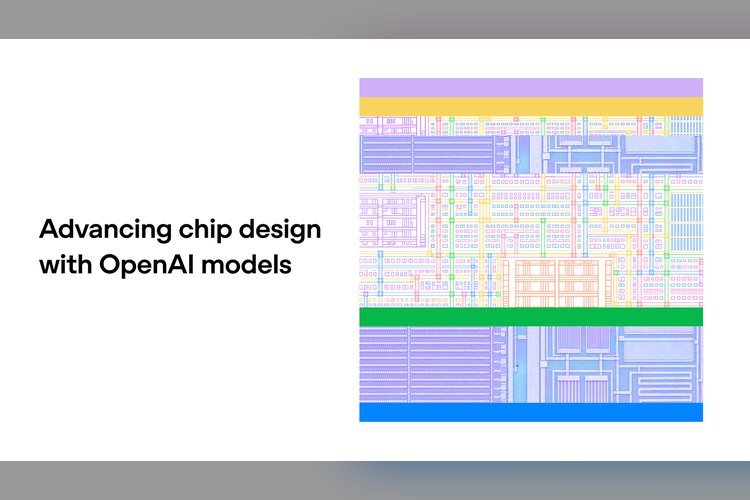
AI chip design moved from experiment to production work this week. OpenAI says its models found real savings on its first custom inference chip, Jalapeño, and up to 14% improvement over heavily optimized baselines on AMD’s flagship GPU IP. It is also working with Synopsys on a model built to run that company’s chip design tools.
What the models changed in Jalapeño
OpenAI began using GPT-o3 mini on Jalapeño in early 2025. Even that early model found non-trivial gains in power, performance and area (PPA).
Inside the vector unit, the part that executes parallel computations, the model trimmed floating-point adders and multipliers, format conversion, reduction logic and the special-function block. It tested other logic styles and other ways to spread the math over pipeline stages, and found spots where circuits could share hardware and store less in between.
Matrix-unit gains came from adders, multipliers and low-precision dot-product circuits. A redesigned multiplier took about 15% less cell area in synthesis, and its latency dropped from two cycles to one. A redesigned adder also saved around 15% of area but still needs two cycles.
OpenAI’s team estimates the accepted suggestions shrank standard-cell area by roughly 13% in the vector unit and 10% in the matrix unit. The silicon bring-up confirmed those optimizations on real chips.
The AMD results
OpenAI also worked with AMD. The models rewrote the SystemVerilog RTL that describes the chip’s circuits and reached up to 14% PPA improvement on the flagship GPU IP. OpenAI puts that at roughly a year of progress delivered in under five months.
AMD has already put some of the changes into a recent design sent for manufacturing. It added others to its production design files for future versions.
On AMD’s next flagship CPU, designs the model produced delivered single-digit percentage PPA gains in key blocks, and AMD verified them itself. OpenAI expects further gains over the best existing baselines on both GPUs and CPUs.
OpenAI says the model handles RTL like an expert microarchitect. It rewrites circuits for arithmetic, control and data movement. Synopsys tools confirmed that behavior stayed identical and compared power, speed and area for each change, so no rewrite was accepted on trust alone.
How OpenAI scored model generations
For a generation-to-generation comparison, OpenAI picked two open-source 32-bit RISC-V cores. PicoRV32 is small and aimed at FPGAs. Ibex is the embedded processor in OpenTitan’s security chip. Both are full cores for microcontroller-class jobs.
Models received the original hardware description and had to raise throughput, meaning instructions executed per second. That measure captures a trade-off: a core might finish an instruction in fewer cycles but run each cycle slower.
Any design that failed simulation, or grew beyond 16 times the original area, scored zero. The rest ran on hidden workloads, and the best throughput seen for each core was set to 1.0.
- With a similar budget of roughly 112,000 tokens a run, GPT-6.2 Astra posted the top average score on both cores.
- GPT-6.1 Sol outscored GPT-5.6 Sol on both.
- All five models scored higher when designing a core from written requirements than when improving an existing design.
- Astra’s edge was bigger on Ibex than on PicoRV32.
In total the study logged 9,881 scored runs.
The catch in the test
OpenAI flags a weakness. Building from requirements lets a model drop features the original cores carry, like performance counters and extra instructions, and those may add little throughput on the test workloads. That could account for some of the lead.
A more realistic test would require those features, set a tighter area limit and check timing after physical synthesis.
GPT-Synopsys and what comes next
OpenAI is also training GPT-Synopsys with Synopsys, a model meant to operate Synopsys’ electronic design automation (EDA) tools like an expert chip designer. Engineers already use that software to design and verify chips.
OpenAI expects more PPA gains on GPU and CPU designs beyond the most optimized baselines. The next checkpoints are the AMD parts now heading to manufacturing and the first output from the Synopsys model.
Source: OpenAI