
AI benchmark grading has a reliability problem. A review of twelve public agent evals turned up signs that the scoring step wrongly failed correct work in eight of them, and a few graders also waved through bad answers. Since a leaderboard number is often the first thing people learn about a new model, those errors travel far.
The anatomy of an eval task
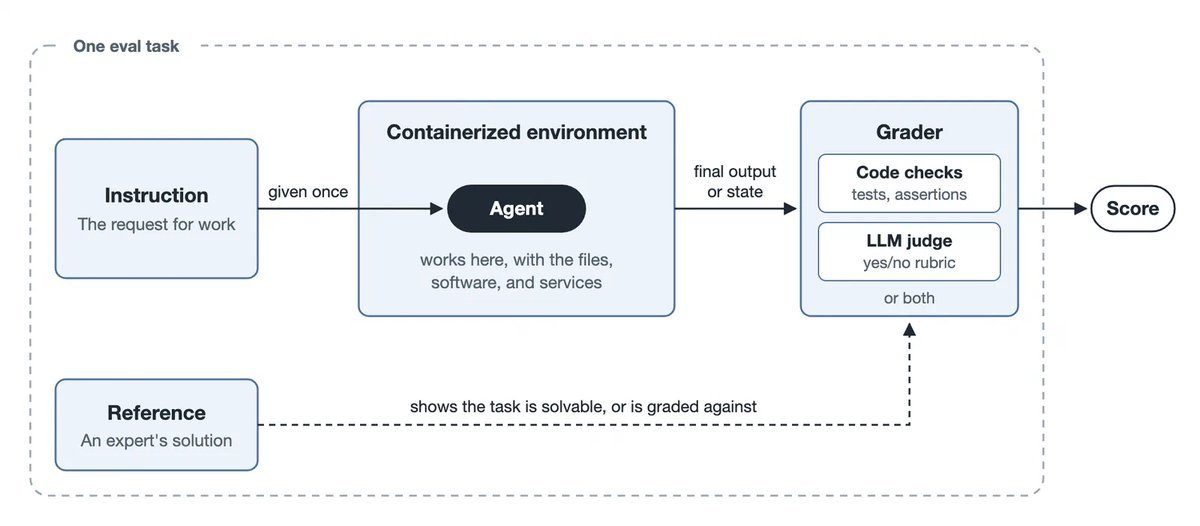
A typical task bundles four things: a user-style prompt delivered once, a sandbox with the files and tools the agent needs, a scoring method, and sometimes a human expert’s solution to prove the task can be done. Coding sandboxes usually freeze a repo at one commit. Office-work sandboxes may be full virtual machines with mock business apps.
Scoring is done by test code, by an LLM judge working through yes/no rubric items, or by both. DeepSWE and AutomationBench skip LLM judges, since plain code returns the same verdict on every run.
These test sets now get versioned like software. Agents’ Last Exam v1.1 retired 30 tasks and edited 57 more. Harvey LAB has grown to 2,010 public tasks from roughly 1,250 at its May 2026 launch. Terminal Bench may drop tasks that models have mastered, which makes scores from different versions hard to compare.
Why agents lose points
Real model mistakes cluster in two places. Some agents hand in work without checking it, or quit early. Others lose track of a requirement written in the prompt. OSWorld 2.0 agents submitted without looking at the final state. On AutomationBench, models finished only part of a list, then reported full success. Ignored instructions were the top failure type in GDPval.
Graders that punish correct answers
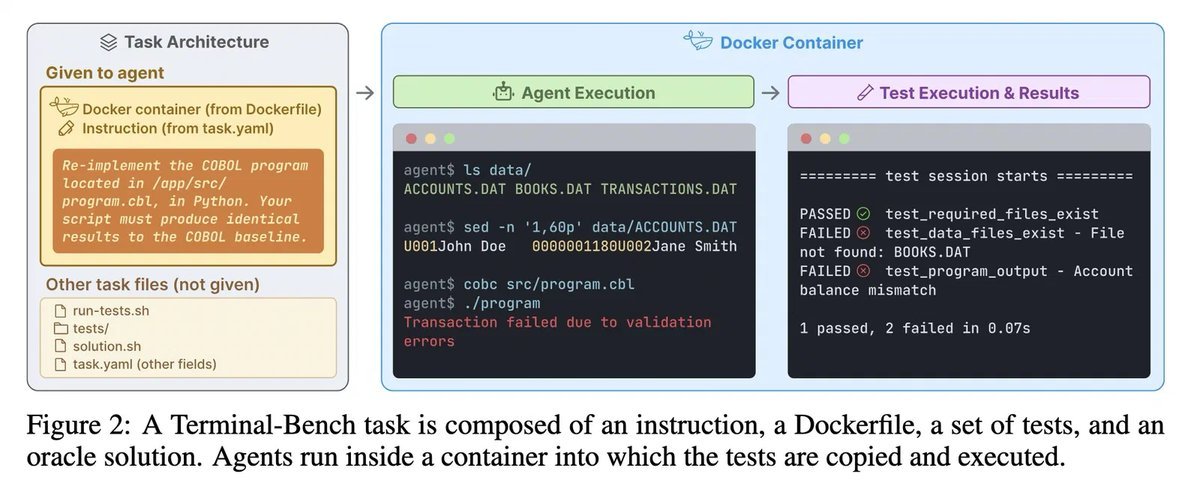
The most common scoring flaw is rejecting good work. Typically a check demands more than the prompt asked for. Reviewers found 41 of 65 Terminal Bench 4.0 tasks relied on requirements the prompt never stated. For DeepSWE, 23 of 113 tasks failed valid solutions. An outside reviewer flagged 23 of 108 OSWorld 2.0 tasks, including one where the checker’s own software couldn’t open the supplied starter file.
Faulty answer keys cause the same trouble. On BrowseComp, trained human solvers disagreed with the official answer for 50 of 367 questions (14%). Harvey LAB dropped 17 criteria that nobody could satisfy.
Wrongly passing bad work is harder to detect, because few teams audit the successes. When Artificial Analysis checked Harvey LAB deliverables against the source documents with an LLM judge, more than 60% of fully passing results contained material hallucinations. In AutomationBench, 55% of assertions only look for a string in a message or record. One task wants an email giving counts of ready and not-ready audit items and only looks for a “3” and a “4”, so swapped numbers still pass.
Two metrics that would help
First, report consistency alongside the average. Picture two agents, each scoring 70%. One reliably solves the same 70% of tasks, while the other solves any given task seven times in ten. Run five trials and require every one to pass, as tau-bench’s pass^k does, and the first agent stays at 70% while the second falls to 17%.
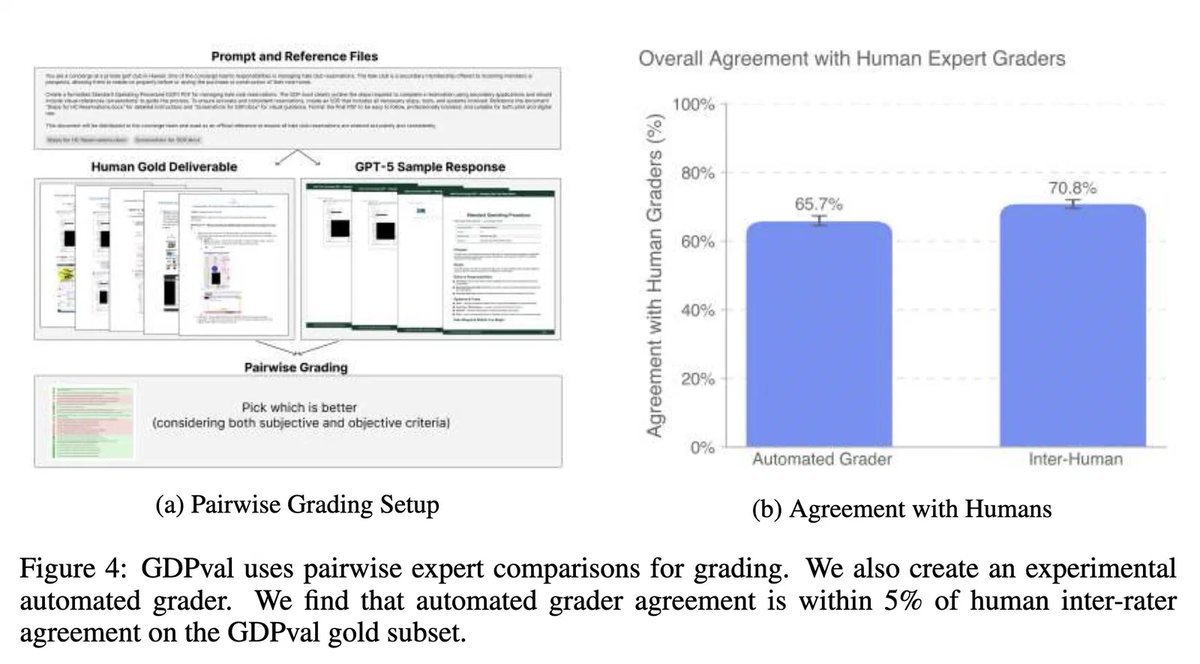
Second, rethink cost. Averages count failed runs, and an agent that gives up fast looks cheap. On Agents’ Last Exam, 17% of failures were early abandonment. In 169 of 170 FrontierSWE trials, one model submitted within eight hours of a 20-hour budget. GDPval’s analysis shows the stakes: GPT-4o cost about a tenth of GPT-5 per task, but after counting the time experts spent reviewing and redoing its output, it was slower than an expert alone, while GPT-5 was faster.
Prompts that arrive all at once are another blind spot. Laban and colleagues measured a 39% average score drop in simulated multi-turn chats compared with single-turn ones. OSWorld 2.0 includes simulated users and mid-task messages, and found agents tend to guess rather than ask.
The surrounding software shifts results too. One model got 57.8% on Terminal Bench 2.0 with the neutral Terminus 2 scaffold and 52.1% with its maker’s own. Another went from 32.6% to 19.6%.
How to fix the scoring
A sensible start is auditing tasks that several top models fail on the same check. Next come negative tests, where known-bad output must be rejected. Terminal Bench uses a do-nothing agent and an adversarial one, yet reviewers still found 44 of 65 version 4 tasks could be passed by cheating. FrontierSWE has a panel of judges read each run to catch reward hacking.
The urgency rises as models get better. Their errors shrink and the scoring bugs stay, so grader faults make up a larger share of what’s left. An audit of DeepSWE v1.1 found valid solutions failed in at least 20% of tasks, mostly because tests the agent wrote or edited collided with hidden ones. Until AI benchmark grading gets as much attention as task difficulty, high scores will keep telling readers less than they seem to.
Source: eugeneyan.com