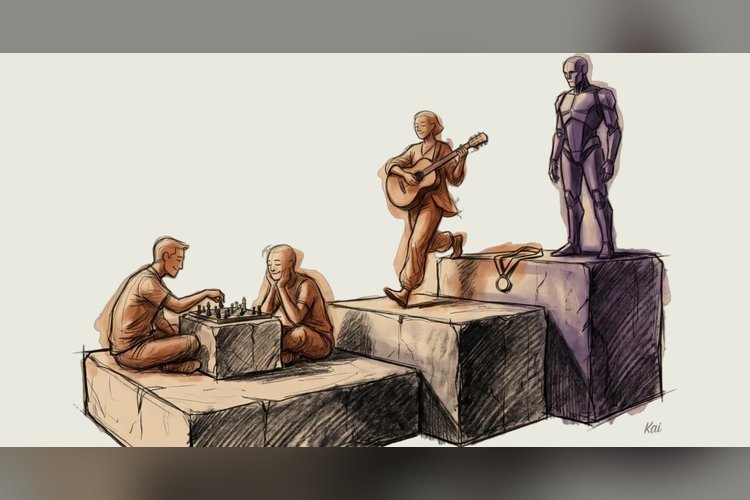
The idea of AI beating humans at the things people value most is moving from prediction to daily experience. One commentator now argues that 2027 will be the year humans step down as the best at several skills we prize, and the list already includes programming, security testing, mathematics and music.
Which fields have already tipped
Programmers went first. For years they were seen as special and elite, and the argument says computers are now better at the job.
Security testers are next. People who hunt for vulnerabilities in applications are watching machines do the same work. Mathematicians appear to have hit the same point only recently, and musicians are getting there too.
Each field had its own reputation as a place where human talent was hard to match. That reputation is what’s now being tested.
Why scarcity decides what we respect
The argument starts with a question: why do we tie value to scarcity? Evolution is the obvious answer. People learned to prize whatever few others could do.
Programmers are the example. Few people could write software well, so the skill carried status. The case for change is that we don’t have to follow that old rule forever, and that a moment when machines match or beat the best humans is a reasonable time to drop it.
Chess already showed what happens next
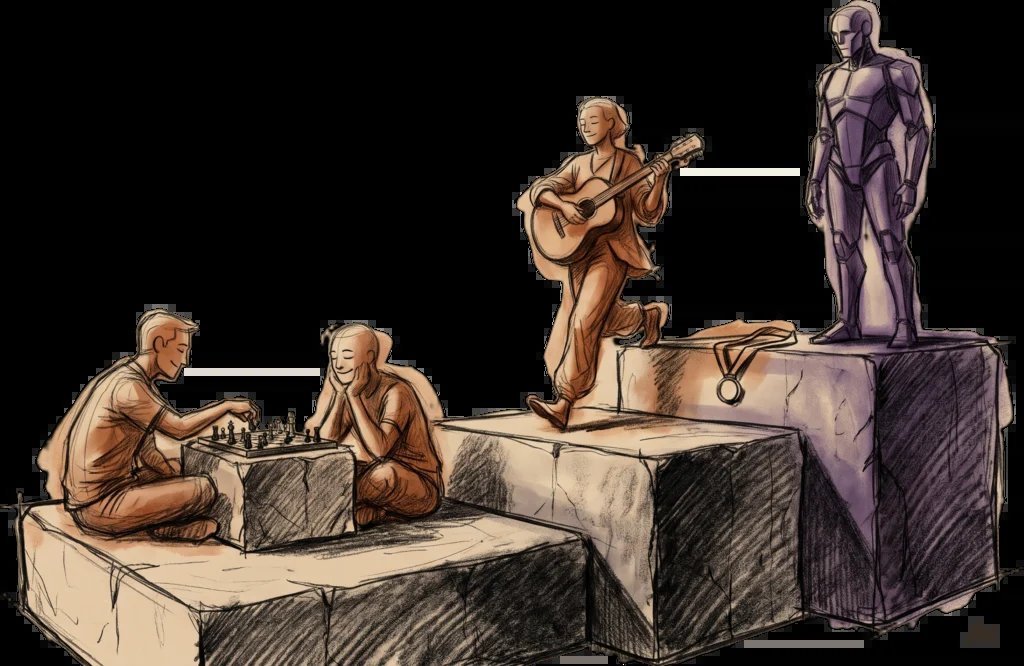
Chess is the clearest precedent. A free iPhone app can beat Magnus Carlsen 100 times out of 100. Even so, chess is bigger than ever, and people still enjoy getting good at it and playing each other.
The same logic stretches to music, art, applications and math. A computer doing them better shouldn’t take away from the human version. Even if machines turn out to be better at making art, or at something people truly cherish, the question the argument asks is simple: so what?
The author gives a personal example from security work. Finding vulnerabilities in applications is enjoyable, even though a top researcher such as Sam Curry exists and would probably find even cooler issues in the same application.
Where the sense of loss comes from
The distinction the argument leans on is which part of the work gives you enjoyment. Several different feelings of loss get mixed together.
It can be disheartening to watch AI finish in a few minutes what would have taken days or weeks, and finish it better than you would have. But calculators already do arithmetic that way, and nobody is bothered by it.
So the real question is which part of the work people attach their identity to. The piece lists three candidates:
- being elite in your field and respected for it
- the time you spent on the project
- the output you create in the end
Most people will probably feel some mix of the three. Which one dominates would shape how each person takes the change.
What the argument does not say
It doesn’t tell anyone to stop writing code, composing songs or testing software. The point is the reverse: human effort in these areas keeps its worth even when a machine produces a stronger result.
That framing also separates two things that often get lumped together. Being the best at something is one source of satisfaction. Doing the thing, and getting better at it, is another. Chess players kept the second one after software passed the first.
What to watch as more fields fall
The argument admits there is more thinking to do as more intellectual pillars give way to AI. It doesn’t claim to have settled how people should feel. Its closing view is that the outcome depends largely on how we look at the change and how we adjust from there.
For anyone working in a field on the list, the practical takeaway is to decide which of those three sources of meaning you actually care about. A person who values the craft, the process or the finished work can keep going. A person whose pride rests on being the best will feel the shift hardest.
The claim about 2027 is a prediction, not a measurement, and no benchmark or dataset backs it here. What it offers is a way to think about the shift while it plays out in programming, security, mathematics and music.
Source: Daniel Miessler