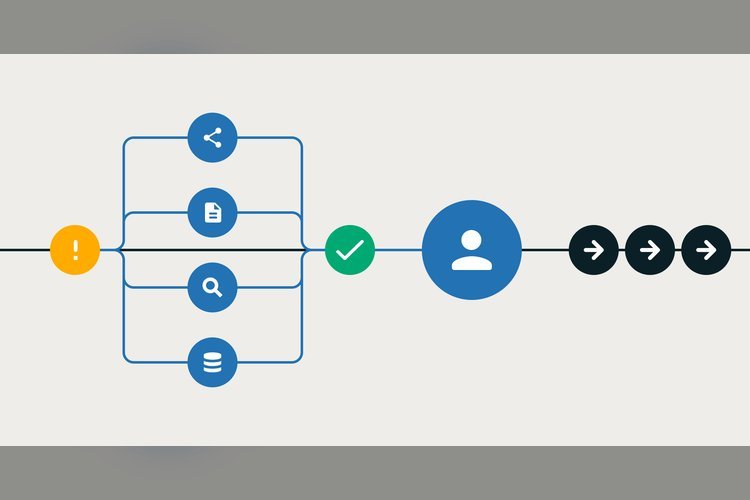
Databricks is proposing four AI architecture patterns for banks and other regulated firms that want agents without giving up control. The ideas come from its Forward Deployed Engineers, who turn fuzzy business problems into live systems. Their message is that the question isn’t deterministic software versus agents. It’s which job each should do.
Regulated systems have to be controlled and auditable, while agents are good at reasoning but can’t stand in for every fixed rule. This opening installment of a five-part series sets out the framework. The remaining four go through each pattern in practice.
Pattern 1: a fixed control with an agent investigating
This fits cases where an outcome must be reproducible or a mistake can’t be undone cheaply. “Deterministic” here means the same result can be regenerated under a versioned contract capturing the data, rule, tolerance, configuration and execution context.
Account reconciliation is the model case. The control calculates balances, applies an approved rule and returns PASS or FAIL. After a failure, an agent can pull evidence, study lineage and batch status, compare with earlier incidents, test a limited list of causes and suggest a next step. It cannot change the tolerance or declare its own explanation a pass. In short, the agent may study the control but never replaces it.
Pattern 2: agent execution checked by a deterministic judge
Choose this when several answers could be acceptable but correctness can be tested. Legacy migration is the example: an agent reads an old workload and drafts new code that may differ each time it runs.
An automated judge then asks whether the code builds, schemas match, data reconciles, totals agree, governance rules hold and performance meets goals. If not, the agent gets the evidence, diagnoses the fault, repairs the work and submits it again. A pass shows the candidate met the agreed acceptance contract. It doesn’t show that the contract covers all production behavior, so test coverage and occasional reviews remain necessary.
Pattern 3: agent reasoning with a human making the call
This one suits questions where judgment is needed and no automated test can prove the answer. Financial crime investigation illustrates it. An agent can link transactions, documents, policies, relationships and past patterns, then propose how to dispose of a case.
A proposal still isn’t a decision. When the result is consequential, a responsible person keeps the authority, and the review sits at the point of decision instead of every intermediate step. Each recommendation should trace to its evidence, sources and tools so auditors and regulators can rebuild the reasoning. Where someone is entitled to an explanation, it must be tailored to that case, naming the main factors and each party’s role. A bare “flagged by the model” falls short. The investigator logs why they decided as they did, including any override of the agent.
Pattern 4: bounded autonomy inside an envelope
Pick this when an agent has to take action but only within set limits. Consider a module for requesting access to governed data. A user describes the data wanted, the reason and the duration. The agent locates the right data product, works out the least access that will do and collects identity, policy, ownership, classification, lineage and usage context.
Approving every routine request by hand slows work without clearly lowering risk, while letting an agent grant anything leaves a gap in control. The answer is to limit the envelope rather than each decision. Inside it, the agent chooses the approved workflow and starts a time-limited entitlement, and policy services confirm every condition before Unity Catalog enforces the grant.
Requests outside the envelope, such as sensitive data, absent attributes, clashing policies, too much privilege or a separation-of-duties exception, can’t run straight through. They go to the data owner, a steward or a risk reviewer.
The governed platform underneath
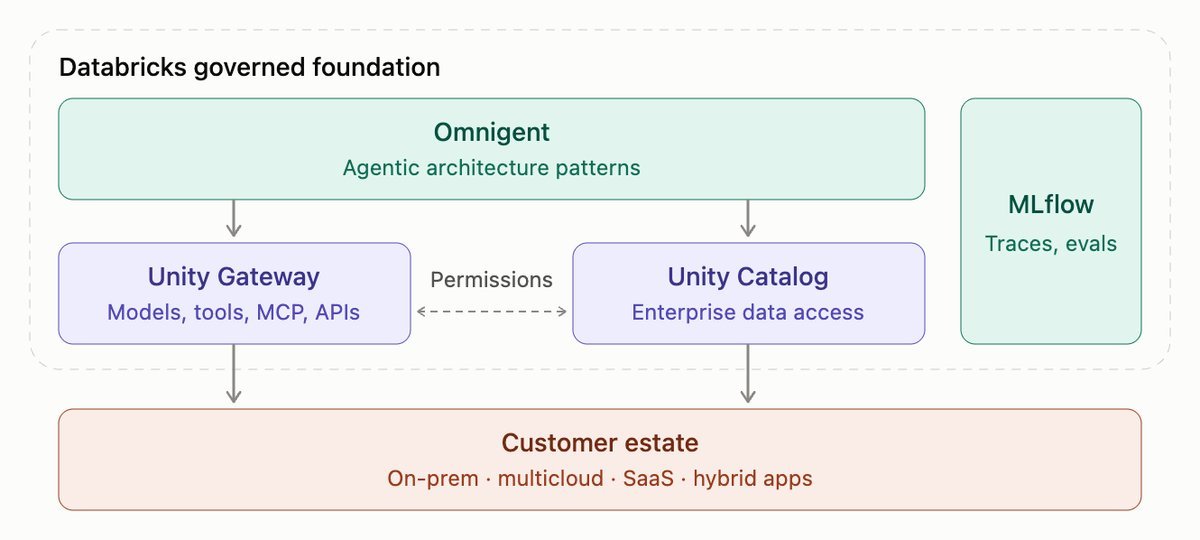
Databricks says one governed foundation sits under all four. Omnigent assembles agents and the tooling around them. Unity Gateway controls access to models, tools, MCP servers and outside APIs. Unity Catalog governs enterprise data and enforces permitted access, including residency and cross-border rules. MLflow stores traces and evaluation evidence that can serve as audit records.
Questions to settle before building
The authors say decades-old deterministic systems often become the base for agentic ones, not casualties of them. They recommend three questions before design starts. The answers show whether a solution needs a fixed control, a judge, a human decision point or an envelope. Model selection comes afterward.
Patterns can be combined. A single production system could use a fixed control for one decision, a person for an exception and bounded autonomy for an approved repair.
What the rest of the series covers
- Part 2: agents looking into exceptions around deterministic financial controls
- Part 3: agents writing and correcting implementations while a judge decides acceptance
- Part 4: Lakewatch combining monitoring signals, bank data and specialist network intelligence into evidence for an investigator
- Part 5: a design for agents coordinating data access inside a policy-defined envelope
Teams working with these AI architecture patterns should classify their use case first, then read the matching article. Cases spanning several patterns should be mapped with a Databricks account team or FDE engagement manager before an agent architecture is chosen.
Source: Databricks