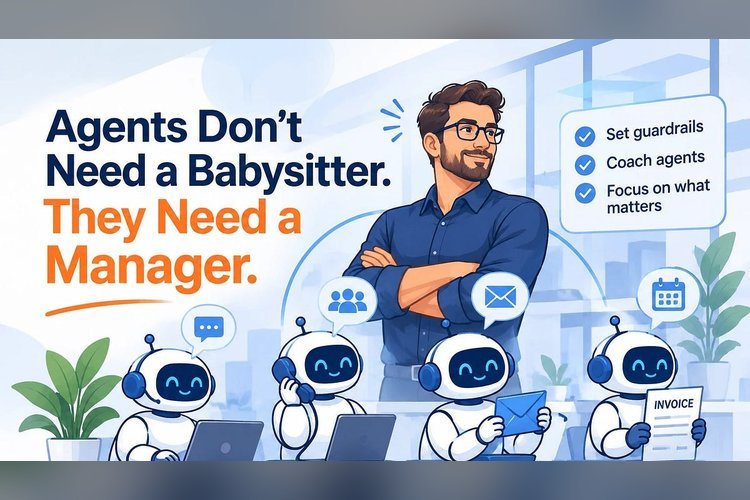
AI agents in the workplace should earn autonomy one task at a time, the way a new hire does, instead of waiting for a human to approve every action. That is the argument from a founder whose software for smaller businesses begins with HR, recruiting and finance. The approval-for-everything model, he says, quietly defeats itself.
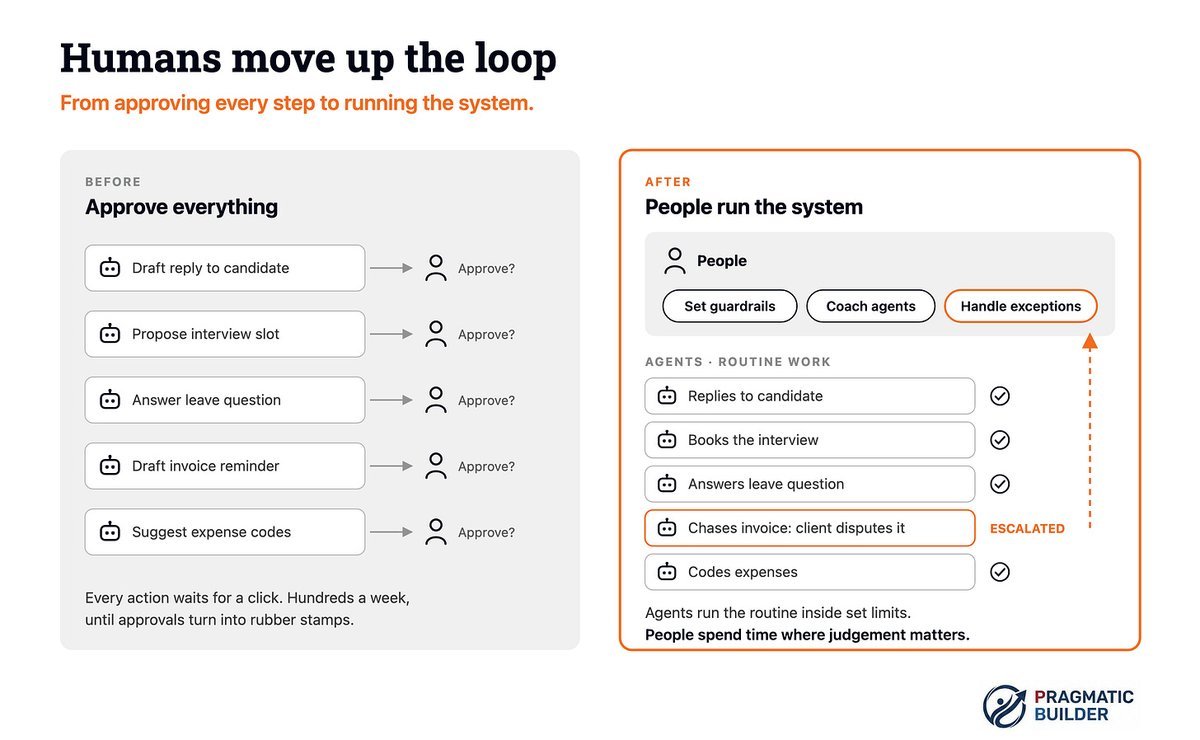
Why constant approval fails
Take an operations manager at a 40-person firm who must sign off on each agent action. Early in the week they read every draft. By Thursday, with 180 approvals behind them, they click through like they’re dismissing a cookie banner. The company pays for a human in the loop and loses most of the benefit.
The alternative is agents that handle routine work alone. A candidate asks at 22:00 whether a role is hybrid, and an agent answers in a minute. An invoice runs ten days late, and an agent sends reminders and calls in a person only if the client disputes it. If a hiring manager’s Thursday afternoon opens up, an agent shifts three interviews into it.
What the research says
Stanford researchers asked 1,500 workers in 104 occupations which tasks they’d want agents to take over. Workers welcomed automation for 46% of tasks, mostly repetitive and low-value ones, mainly to make room for better work. The skills that most need a human were increasingly interpersonal and organisational, such as planning, coordinating and teaching.
In an experiment run by Harang Ju and Sinan Aral, 2,234 participants made ads alongside a randomly assigned partner, either a person or an agent. Teams with an agent turned out roughly half again as much per worker, and participants handed the agent more work than they gave human partners.
There’s a caution. McKinsey’s 2025 survey on AI adoption put regular use at 88% of organisations, yet under four in ten saw any company-level earnings impact. The author’s reading is that bolting an agent onto an old process produces a demo, while redesigning the work produces results. A 40-person company can redo a process in a week.
Treat each agent like a new hire
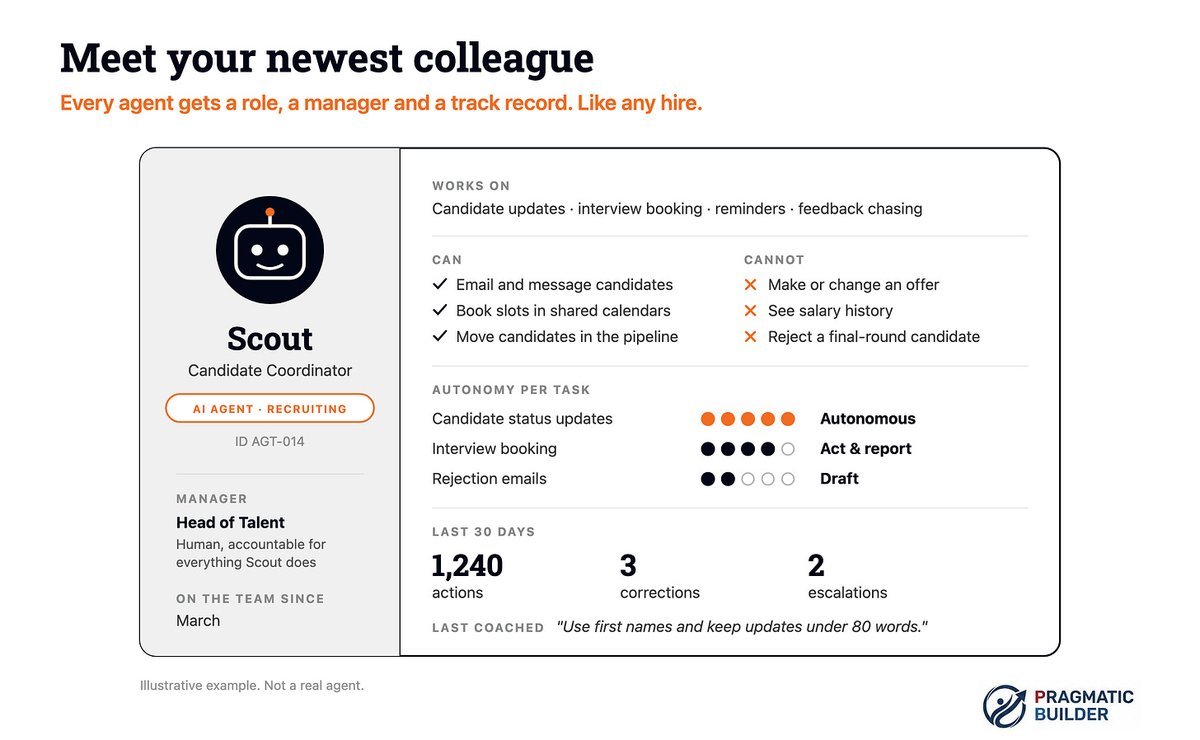
Every agent gets a name, a role, a human manager who answers for it, a defined set of permitted and forbidden actions, and a track record anyone can see.
Big vendors are heading the same way. Microsoft’s Entra Agent ID assigns each agent an identity and lifecycle, with a human sponsor who stays accountable through staff changes. Workday unveiled an “Agent System of Record” in 2025 for managing agents next to human staff. Much of that is still announcement rather than proven practice.
Autonomy by task, not by agent
Safety works as a ladder that every task climbs on its own. One agent can send candidate status updates on its own, book interviews on an act-and-report basis, and still only draft rejection emails. It moves up with a good record and down after mistakes.
- Start each task at the rung its risk allows. A bad interview slot is fixable, while a bad payment isn’t.
- When unsure, the agent escalates. Wrong and confident is the expensive failure.
- Every action is logged against the agent, the task and the accountable human.
- People keep ownership of job offers, dismissals, large payments and delicate conversations.
Tooling exists for this. LangGraph can halt a workflow at a checkpoint until a person responds, then resume. AutoGen from Microsoft seats the human inside the agents’ conversation, and HumanLayer lets agents request approval mid-task.
Agents that learn, teams that flex
Each action has an outcome: whether the candidate replied, the invoice was paid or someone corrected a message. Those signals, plus standing instructions from operators such as copying the hiring manager on schedule changes, feed back into the agent’s playbook. The human becomes a coach who sets guardrails and handles exceptions.
Small companies also live in peaks, such as month-end close or a hiring rush after landing a large client. Agents can stretch to the peak and shrink back, and for a team of five that elasticity matters as much as the hours saved.
Open questions that remain
The Stanford survey also found that workers want more say than the technology strictly demands, and most prefer an equal partnership. That clashes with the direction described here.
Another problem is entry-level work. A separate Stanford study, “Canaries in the Coal Mine,” draws on payroll data and ties generative AI to shrinking employment among young workers in the most exposed occupations. If agents take the junior tasks, juniors need another way to learn. One suggestion is teaching them to coach agents early, since that requires understanding the work well enough to explain it.
What small teams may look like by 2028
The author expects every small company to run a mixed team within two or three years: a handful of people working with a bigger set of agents that each have an assigned role, an owner and a visible record. The winners, the argument goes, won’t be the firms with the most agents but the ones where staff spend their hours on what only people can do.
Source: pragmaticbuilder.io