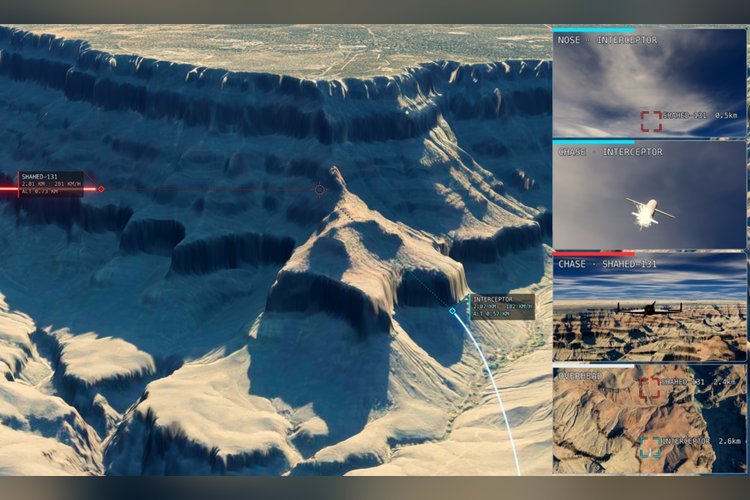
Agon, a defense AI startup based in the UK and Berlin, has closed a $70 million Agon Series A at a $450 million valuation. Northzone led the round, with existing investors Lakestar, XYZ, Lux Capital and Global Founders Capital also taking part. The money arrives less than five months after the company came out of stealth with $30 million.
The new funds will push Agon beyond the simulation tools it launched with. The company now wants to train foundation models for defense, and it describes the goal as building an “AI lab for European defense.”
Who backed the round
Two public bodies joined the private investors: the UK Sovereign AI Fund and the National Security Strategic Investment Fund, known as NSSIF. Roelof Botha, the former head of Sequoia, has also come in as an investor.
Government money in a round this early is a signal in itself. European defense tech has spent years being told it can’t raise at the pace of its American rivals. A $450 million valuation for a company founded only this year suggests that argument is losing ground.
What Agon built first
Agon was founded earlier this year by Tristam Constant, who previously worked at Applied Intuition, Anduril and the British Army, and Junaid Hussain, a co-founder of Cambridge Aerospace and Iconic. David Helgason, who founded the game engine company Unity, chairs the board. That background fits a company whose core product is a synthetic world.
The product is a virtual training ground for autonomous systems. Models face simulated adversaries, driven by real-world data, and improve through repeated runs. Constant calls it a “gym for training defense AI” and a “synthetic battle lab.”
The pitch to drone makers and militaries is about cost. Testing autonomy in the field takes thousands of hours and a lot of money, and losing an expensive aircraft in a test hurts. Losing a virtual one doesn’t. Hussain said real-world experiments are too expensive, too slow and too hard to scale, and that nobody can run billions of different experiments outdoors or cover dangerous edge cases.
The team has also recruited people from Anduril, Applied Intuition, Google, Helsing, Palantir, Amazon and Havok.
From simulator to model builder
As the team scaled the simulated battleground over recent months, it concluded the same setup could be used to build models directly. Constant said training foundation models for autonomous systems gets too little investment today. Hussain went further and called it “existentially important” to push beyond providing infrastructure.
“We have built the gym. Now, we’re going to start training athletes,” Constant said.
The simulation also lets Agon test against threats that don’t exist yet. Hussain gave the example of a Geran drone that travels 1,000 km/h. The team runs experiments like that every day, asking how existing capabilities would hold up against a future threat, or where a planned system might fail.
Agon wouldn’t say exactly where its training data comes from. The founders described a mix of defense inputs, customer data and open-source material available online. They said they use a large volume of it to keep the training environment close to real time and up to date.
Where the $70 million goes
The Agon Series A is mostly a bet on people and compute.
Building an AI lab costs a lot, which explains how fast the second round followed the first. Most of the money will go to hiring AI researchers who want to work on security and defense. A large share will also pay for compute, along with the research and development a new lab needs to get started.
Constant framed the raise as a race. “Europe is in an AI arms race, whether it chooses to recognize it fully or not,” he said, adding that adversaries are already investing and that Europe currently lacks what is required. He said the company will grow in a deliberate way, but that time is of the essence.
The company’s aim is to become a one-stop shop for defense AI in Europe: the place where the best models are built and trained, and where autonomous systems get checked before they reach the battlefield.
What to watch next
Agon’s shift from tools to models puts it in a more crowded and more expensive field. It will need to show that its simulated data produces models that perform outside the simulator, and it will need customers willing to buy them.
Three things will tell how well this Agon Series A was spent:
- How quickly it hires researchers for a lab it only just decided to build.
- Whether defense ministries and drone makers sign on to train on its platform.
- Whether it names its data sources, which the founders so far have not.
With a $450 million valuation and public funds in the cap table, expectations are now set for a startup that is less than a year old.
Source: Tectonic Defense