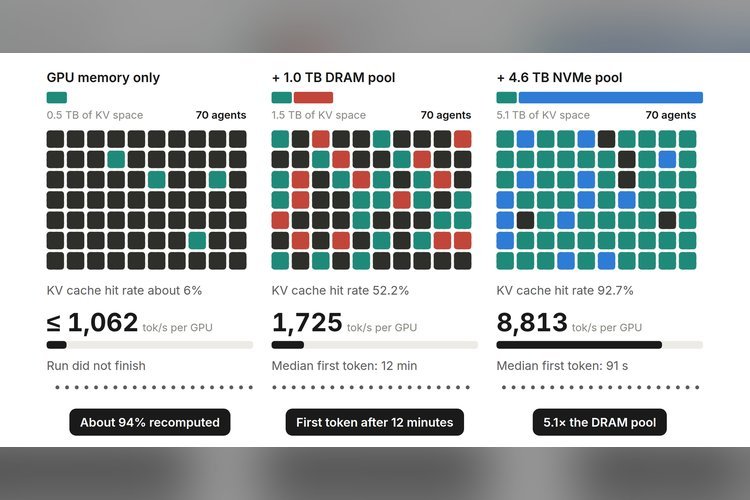
Testing an agentic KV cache on NVMe storage for vLLM, AMD and partners saw throughput land within 1 percent of an equally sized DRAM setup. The runs served Kimi-K3 on MI355X accelerators with UMBP, a cache pool inside AMD’s open-source MoRI library. If the result holds, serving teams could skip the expensive DRAM tier for long agent sessions.
Why agent traffic strains memory
Agent sessions run for many turns, and each turn resends a huge chunk of earlier context. AgentX, a benchmark built from real Claude Code sessions, shows a median turn of 142K input tokens, with more than 96 percent already seen by the server.
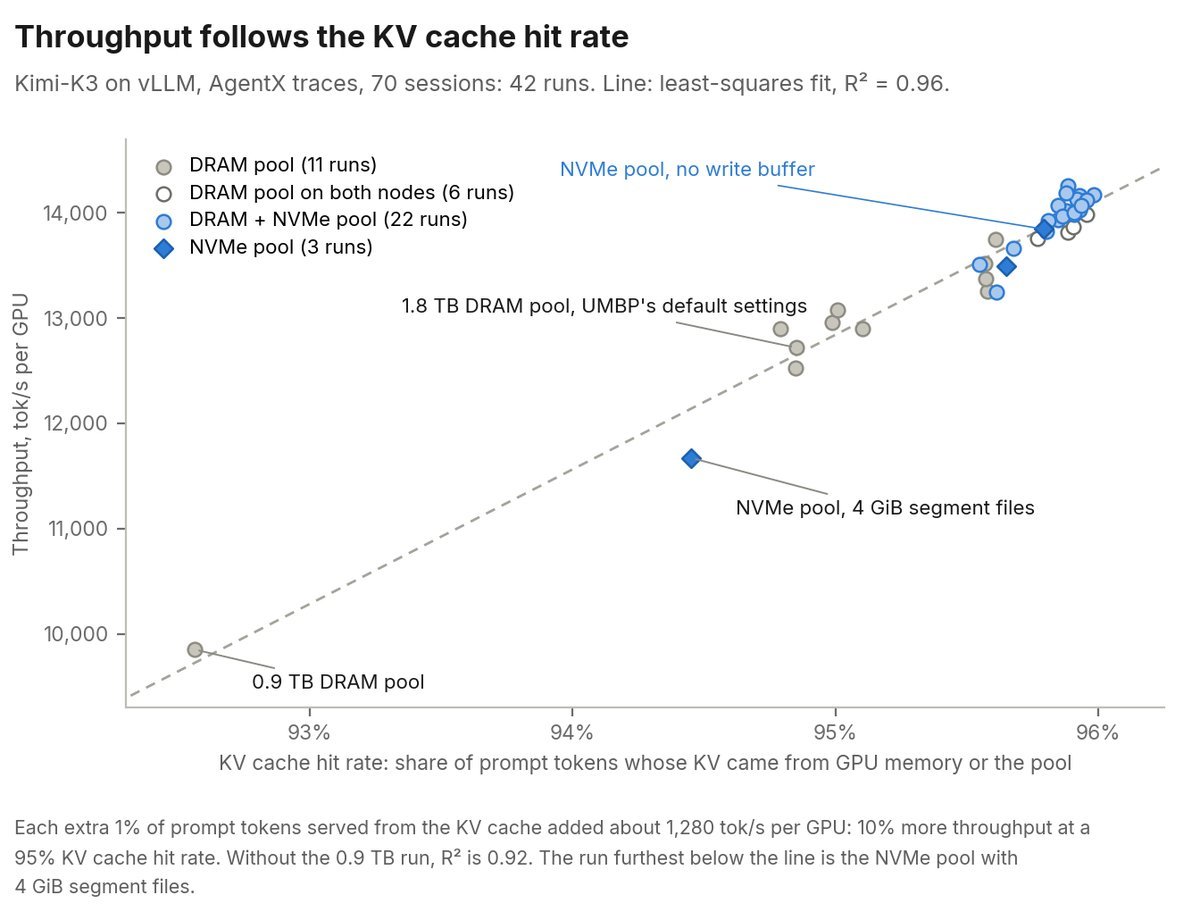
When the cache has the prefix, prefill only works on the new tokens. When it doesn’t, the GPU redoes everything and users wait longer for the first token. Over 42 Kimi-K3 runs on vLLM, moving the hit rate from 95 to 96 percent of prompt tokens lifted throughput by roughly 10 percent.
Capacity is the problem. Kimi-K3 produced 2.3 to 4.6 TB of KV every hour. A 1.8 TB DRAM pool, priced around $76,000, covers only the latest 23 to 47 minutes.
The NVMe pool setup
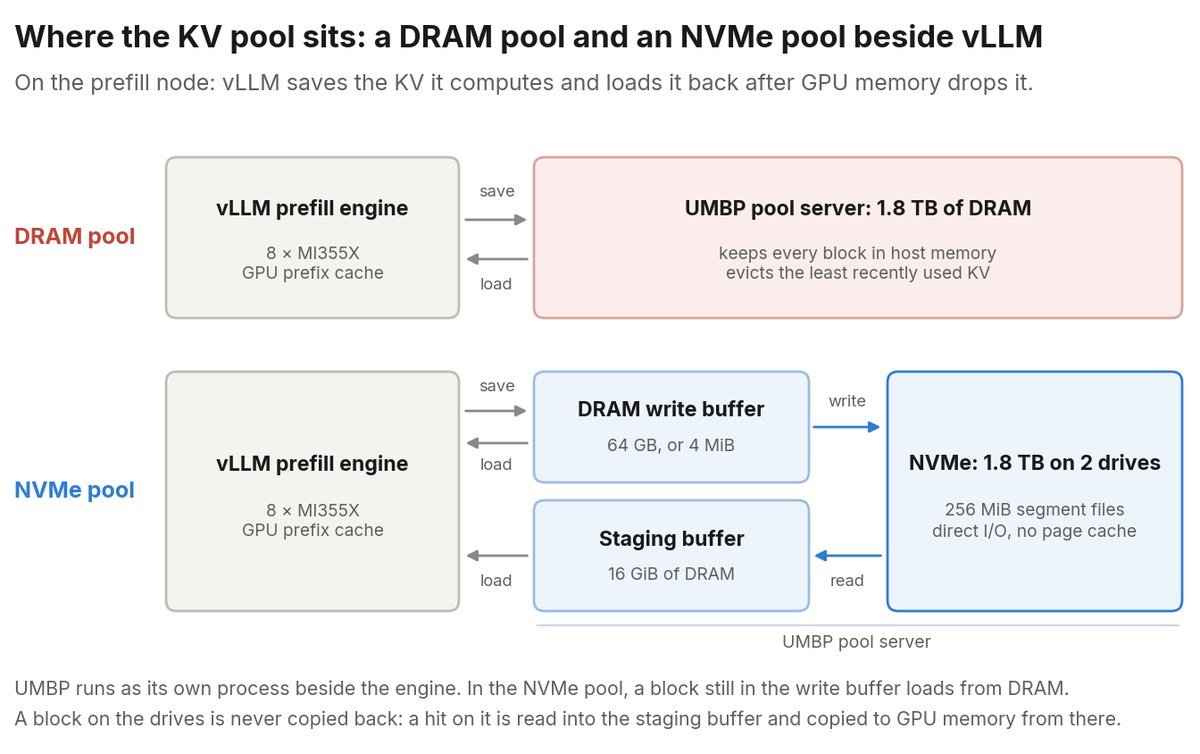
Inside vLLM, recent prompts stay cached on the GPU, and the oldest blocks get evicted when space runs out. A KV pool catches that overflow, so a session that comes back can reload its prefix.
Two pools of 1.8 TB each went head to head. One held all blocks in host memory. The other wrote new KV to a 64 GB DRAM buffer (in most runs) that drained to two local NVMe drives per node. Blocks read back from disk went through a 16 GiB staging area on the way to the GPU. DRAM use totaled about 80 GB, under 5 percent of the pool.
Each node used two 3.84 TB Micron 7450 PRO drives, rated for roughly one full write per day and not set up as RAID. UMBP reads them with direct I/O over io_uring, which keeps the Linux page cache out of the picture.
The workloads ran as 1P1D on 16 MI355X GPUs, with TP8 prefill and TP8 decode. Load came from two replayed sets: 393 recorded Claude Code sessions, and roughly 3,200 sessions of WEKA agent traffic captured from 5 September to 14 October 2026.
What the numbers showed
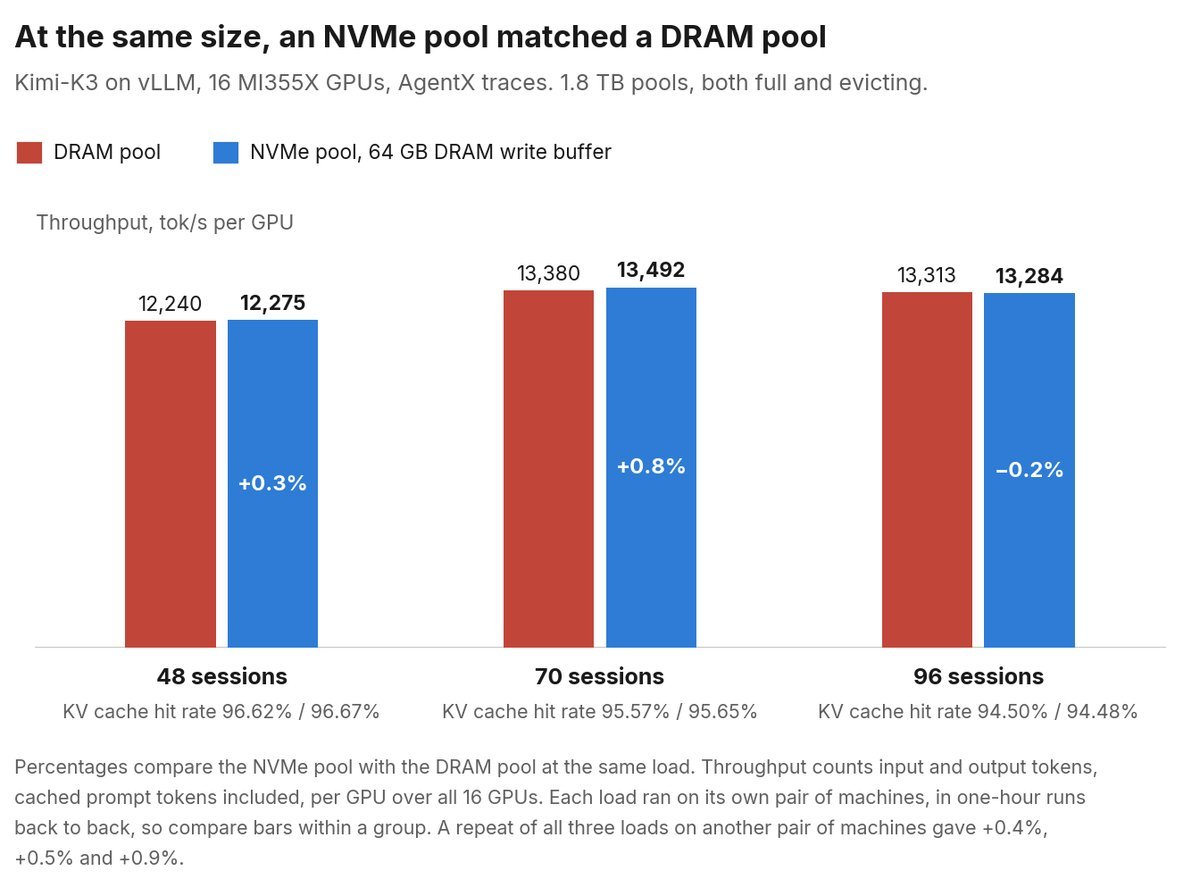
- Kimi-K3 throughput on NVMe tracked DRAM to within 1 percent with 48, 70 and 96 users at once. Two separate machines gave the same result.
- A second test with longer prompts, at 70 sessions, showed the same gap of under 1 percent.
- Dropping the write buffer entirely cost nothing at 70 sessions, though heavier loads call for keeping it.
Hit rate explains it. Pools of equal size with the same eviction policy retain the same data. And since vLLM loads KV asynchronously, the slower disk read completed while the request was still queued for prefill.
Cost and retention
The cost gap matters because retention decides whether a returning session finds its prefix. A pool that forgets after half an hour misses every session that pauses longer than that, while a day of history catches most of them.
With DRAM you pay for each terabyte you keep. With NVMe you pay for each terabyte you write. At list price, about $59,000 buys drives that can absorb Kimi-K3’s 83 TB of daily writes and keep 24 hours of cache. The $76,000 DRAM pool keeps 31 minutes.
Dennis Kennetz, a principal infrastructure engineer at Oracle Cloud Infrastructure, said the result changes how his team plans cache capacity. DeepSeek already works this way: its DeepInfer engine notes cite three days of agent cache kept on around 14.4 TB of SSD for each GPU.
The catch and the next step
The GPU’s every newly computed block lands on the drives, and that wears them down. The planned remedy is a distributed pool that shares the write load across more SSDs. The pool also served DeepSeek-V4-Pro and DeepSeek-V4.1-Flash in supporting tests. Until the distributed version arrives, operators should check drive endurance ratings against their write volume before moving off DRAM.
Source: vllm.ai