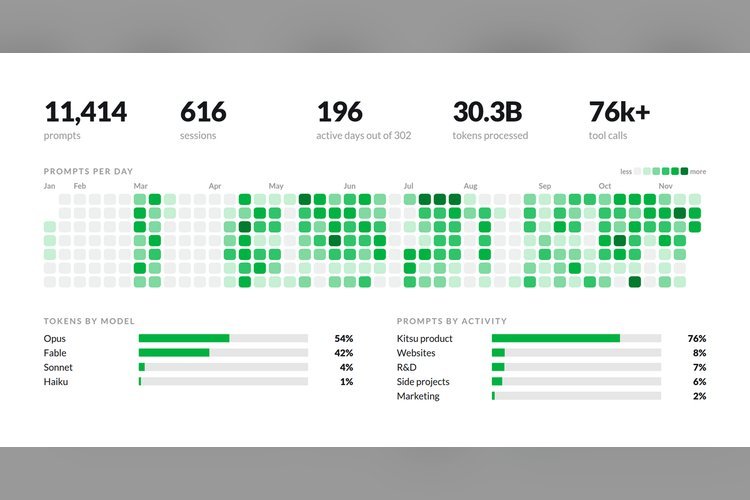
After ten months of agentic coding on an open-source project, the lead developer of Kitsu, CGWire’s production-tracking software, says a five-person team shipped what would normally take far more people, for about $2,000 in subscription fees. At API prices, the same usage would have cost around $30,000. He used 70 billion tokens along the way.
The developer, an engineer with 20 years of experience, began using coding agents in January 2026. He stuck with Claude Code on the Ultra plan, and the team pays $600 a month for three subscriptions.
What got done
Kitsu runs in production for about 20,000 daily users and has been deployed in 400 companies, so wild experiments weren’t an option. Within that limit, the list is long:
- A migration of 300 Vue.js components from the options API to the composition API, and a responsive redesign of a previously non-responsive app
- Stronger backend security and high backend test coverage, plus 6,500 new frontend tests
- An MCP server, a complete JavaScript client for the API and a new Tauri desktop app
- 70 open issues cleared, with no more than 10 open at once since

Prompting: start short, iterate
He never liked writing detailed specifications, so he starts with short prompts and iterates. Vague prompts leave room for the model to suggest ideas he hadn’t considered. Whenever the model misbehaves, he has it save the lesson to memory or the project’s Claude.md file, which also applies to outside contributors. He asks for concise answers because models develop their own jargon as conversations grow.

Where agents work best
Codebase QA is the strongest use. Models handled linting rules, API specs, documentation, test writing and dependency upgrades with little supervision. He split work into separate sessions by module, because too much data confuses the model. Once the code was clean, he asked for a security audit, then a full audit across eight areas: architecture, bugs, security, cleanliness, test coverage, performance, documentation and dependencies. He turns each report into a to-do list, prunes it and runs a loop that applies and commits every item. He now repeats this with each new model release.
For data migrations, he asks for a script instead of letting the model touch live data. Scripts are deterministic, readable and interruptible, and models tend to add a dry-run mode on their own.

Skills and memory
Skills, saved long prompts that the tool loads on demand, became the main way to set up his workflow. He had the model write his first set, and it later proposed new ones from his prompt history. To share memory between desktop and laptop without relying on a vendor service, he built a memory app inside his own personal cloud, which keeps the setup portable across tools.
Where it gets harder
Models keep suggesting more improvements, so knowing when to stop is the hardest skill. Small fixes grow into refactors. He tells the model to take the shortest solution. UI work needs the most iterations, since spacing, widgets and branding often come out off.
He also compacts sessions before they pass half of the context window, avoids mixing subjects in one terminal, and treats hitting a usage limit as a cue to stop for the day.
His concerns
Agentic coding on an open-source project isn’t free of cost for the people doing it. The benefits come with worries he lists plainly: reliance on third-party providers, ethical objections, a heavier cognitive load because agents let you maintain far more, and a sense that craftsmanship is ending. He describes exhaustion from prompting all day and pressure to master a technology that hasn’t settled. He recommends not forcing anyone to use LLMs, since most will anyway, and he doesn’t claim to know whether using AI is right. He doesn’t see how to opt out of the trend either.
The open question for small teams
With agentic coding on an open-source project, bottlenecks shifted to other departments, such as training and sales, which AI can’t speed up. Once QA is finished and backlogs are empty, he wonders how many engineers will be needed, and whether software will come to need both human and agent effort or simply fewer developers.
Source: Frank's Blog