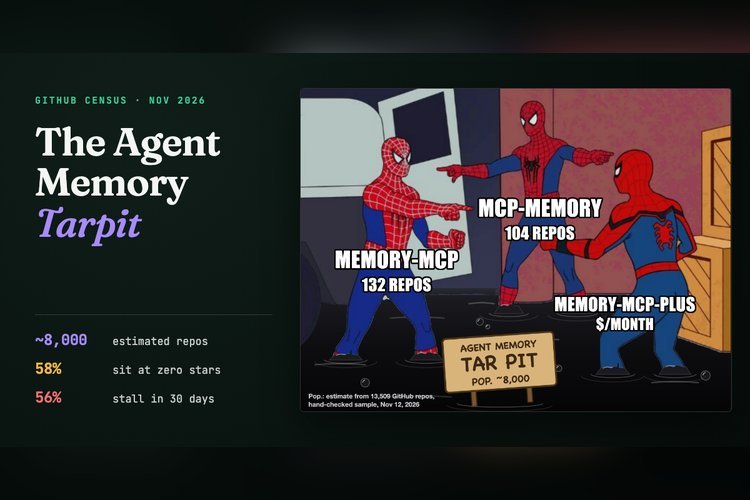
Agent memory MCP servers have become a startup tarpit, an idea that looks obvious, attracts waves of founders and keeps failing. A census of public GitHub repositories on 12 November 2026 estimates roughly 7,970 agent memory MCPs, and most of them go nowhere. Y Combinator describes a tarpit as an idea where nothing structural has changed to remove the old obstacle, and classic examples include note-taking apps.
What the GitHub numbers show
Searching public non-fork repos with both mcp and memory in the name returned 1,530 results. Widening the search to names, descriptions and topics returned 13,509. A hand-labeled random sample of 200 found 118 primary agent-memory projects (59.0 percent), which puts the pool near 7,970. That is a floor, because the keyword filter misses 9 of the 13 largest memory projects that ship an MCP server. Those 13 together hold 506,637 stars, led by claude-mem (116,633), Mem0 (68,898), Hindsight (60,745), Graphiti (32,787) and Supermemory (31,606).
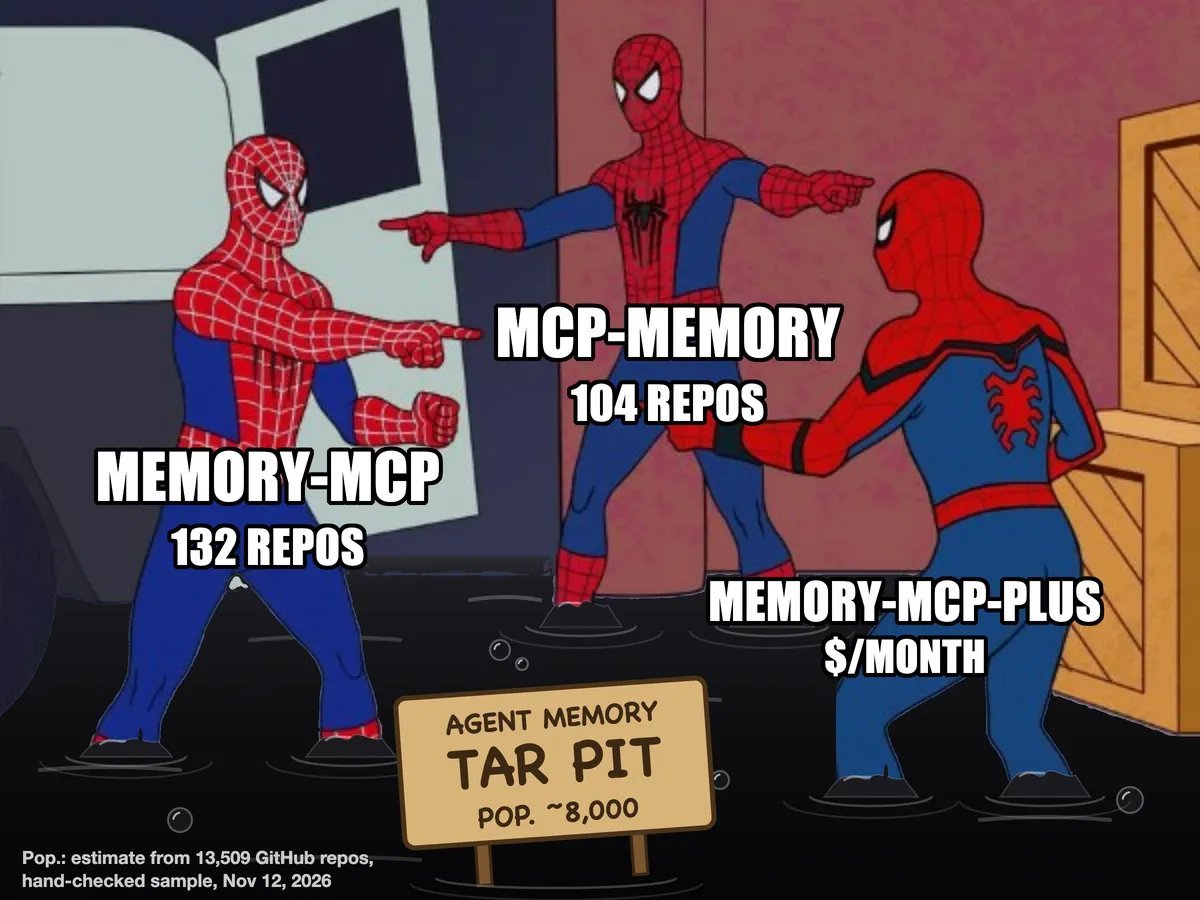
Creation of repos with the literal names peaked in April 2026 at 132. After that, builders kept going but started choosing neuroscience terms and Greek mythology for names.
Attention is thin. Across the 118 confirmed repos the median is 0 stars, and 87.3 percent have 5 or fewer. Among the 113 repos at least 30 days old, 55.8 percent stopped receiving pushes within 30 days, with a median active span of 18.2 days. Only 29.2 percent saw any push between 24 October and 23 November.
The friction of being a third party
Memory behind an MCP server lives inside someone else’s host, and that costs. Take a user who says “I live in Austin” in March, “I moved from Austin to Seattle” in June and asks for a nearby dentist in July. The model might skip the save call in June or the search call in July, since listing a tool does not guarantee it gets used.
- Tool schemas cost 200 to 500 tokens each before the first turn, and one sampled repo exposes 38 memory tools.
- Variable tool outputs work against KV prefix caching, where hosted providers discount cached prefixes about 10 times. Built-in memory sits in a stable prefix.
- Pure MCP cannot passively capture turns between calls.
The biggest coding-agent memory projects work around capture with lifecycle hooks. Both claude-mem and OpenViking do this and use MCP mainly for search. Hooks exist in local developer CLIs, but not in consumer apps such as ChatGPT or Claude on web and mobile, and hook formats differ between tools.
Hosts ship memory themselves
Major hosts now have built-in memory, and MCP itself ships a reference server. Claude and ChatGPT both accept third-party connectors, so external memory works today. But memory locks users in, which is why Anthropic built an importer for preferences from rival chats. There is little reason for a host to keep an outside server as fast or as well tied into prompt caching as its own.
Vector, graph or files
Vector stores are the most common backend, at 30.5 percent of described repos. They match by topic, so both Austin statements come back in July, and swapping embedding models forces a full re-index. Knowledge graphs account for 10.5 percent and can expire the March fact, but that takes bi-temporal tracking and entity resolution, plus extra LLM calls on every write. In Mem0’s LoCoMo ablation the graph variant used about double the context tokens and triple the p95 search latency for a 1.56-point gain.
Filesystem and SQLite designs (14.3 percent Markdown or files, 18.1 percent SQLite or FTS5) are easy to read and debug. Letta reported gpt-4o-mini reaching 74.0 percent on LoCoMo with flat files and basic search. Their weakness is indirect prompts like “near me” and stale lines that pile up unless pruned. Across the sample, all four storage types stall at similar 30-day rates.
Where external memory still works
Four narrower cases hold up: custom vertical agents built on an SDK or API, portability across coding tools, shared and governed team memory, and local-first or regulated environments that cannot send transcripts to a consumer cloud. Mem0 (YC Summer 2024, $24 million raised across seed and Series A in October 2025), Supermemory, Zep, Graphiti and Letta do not rely on a standalone consumer MCP wrapper as their core product.
Building one as a weekend project teaches chunking, extraction and retrieval. Launching another memory SaaS on top of it is the advice not to follow.
Source: morethanamachine.com