Collabora has released Aavaaz, an open source server for self-hosted Whisper transcription that adds many features people normally rent from commercial services. It extends the company’s earlier WhisperLive real-time server and carries an MPL 2.0 license.
Whisper is accurate and fast offline on GPU or CPU. The hard part is serving many users, with access control, redaction, notifications and speaker labels. Aavaaz is meant to cover that.
Input options and backends
Live audio arrives over WebSocket with latency under a second, from a microphone, a file or an RTSP or HLS feed. Recorded audio uses a REST endpoint modeled on OpenAI’s transcription API, so existing OpenAI client code only needs a different base URL. Results can also stream back as server-sent events.
Multi-channel recordings can be separated per channel and recombined on one timeline, handy for call-center audio where agent and customer sit on different channels. Language is detected automatically and returned with a confidence value.
Behind the one API sit three engines. Faster Whisper is the default for CPU or GPU, with int8 or float16 quantization and support for custom models. TensorRT-LLM targets NVIDIA hardware for peak throughput. OpenVINO covers Intel processors. A developer can prototype on a laptop and swap in TensorRT later without touching client code.
Setup is two commands: a pip install of aavaaz with the whisper extra, then aavaaz serve with a backend and model. The WebSocket listener uses port 9090 and the REST service port 8000.
A plugin chain for transcripts
Each segment passes through post-processing plugins in a set order. They can be toggled or replaced with custom ones, and a failing plugin never blocks the segment.
- Diarization uses pyannote.audio embeddings to group voices as audio streams in, labeling them SPEAKER_00 and so on. Enrolling a few voice samples swaps those for names such as Alice and Bob.
- Word-level timestamps and confidence scores support subtitles and jumping to a spot in a recording.
- Hotwords raise accuracy for product names, acronyms or drug names. Find-and-replace rules, literal or regex, correct habitual errors like “cube ernestes” to Kubernetes. Near-field and far-field noise reduction handle steady hum and changing background noise.
- Smart formatting converts spoken numbers, dates, currency and percentages into written form. Filler removal strips ums and uhs, and an aggressive setting also drops words like “like”.
- PII redaction removes Social Security, card and phone numbers plus email and IP addresses before a transcript leaves the server. A profanity filter can mask, blank or delete words from an editable list.
- Audio intelligence tags sentiment, keywords and entities per segment, and adds summaries, highlights and chapters per recording.
Most of these switch on through command-line flags.
Production plumbing
API keys guard both the REST and WebSocket sides, and a client with a bad key is turned away before the server reserves any GPU memory. An account API manages tenants, keys, usage and billing. Single sign-on accepts tokens from Keycloak, Cognito, Auth0 or Okta.
Batch inference pools audio from several sessions into one GPU pass. If the queue backs up, newcomers wait instead of degrading current users. REST traffic is rate limited per IP with HTTP 429 responses, and Prometheus metrics expose connections, latency, audio volume and request counts.
Saved transcripts can be searched by language, model, tags and dates. A usage API breaks down requests, audio minutes, characters and cost per user. For GDPR, an operator can export a user’s records as JSON, remove one transcript or wipe everything for that person. Webhooks deliver completed transcripts, retrying with exponential backoff.
Deployment and fit
Client libraries exist for Python, JavaScript and TypeScript, and Go. Deployment targets run from a Raspberry Pi to GPU clusters: Docker images, a Helm chart, AWS via Terraform, a Lambda batch mode, Modal GPUs that scale to zero, and ARM64 boards like NVIDIA Jetson. A guide covers fine-tuning Whisper on medical, legal or accented speech.
The selling point is control over data. Call and meeting recordings are often among a company’s most sensitive material, and shipping them to an outside API isn’t always acceptable. Call centers, meeting assistants, medical transcription and media indexing are natural uses.
Demo and next steps
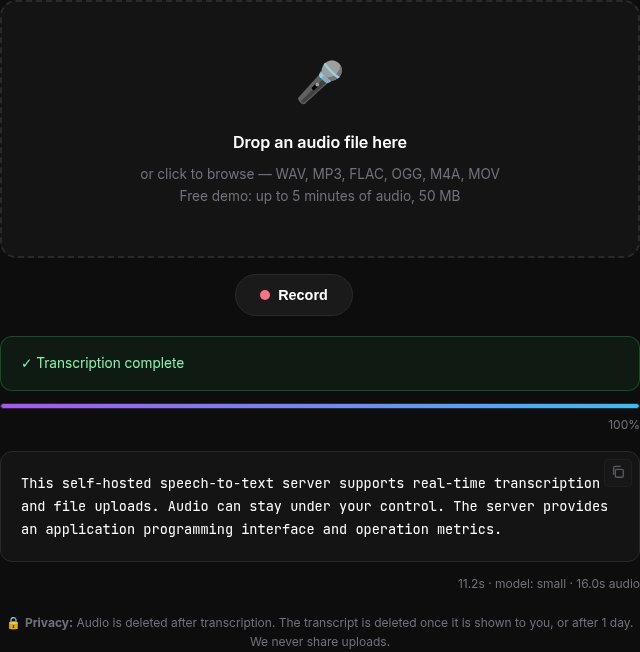
A public demo handles live speech with Whisper large-v3 on a Modal T4 GPU. Expect a wait of 10 to 20 seconds on the first request while the GPU spins up. Live audio is processed in memory and discarded. The file demo uses Whisper small on AWS Lambda, accepts WAV, MP3, FLAC, OGG, M4A and MOV up to five minutes and 50 MB, and deletes audio after transcription.
The code is on GitHub. Collabora invites users to share hardware results, file issues and contribute backends or plugins.